Loading…
GameBrief · General
Pratfall Items Guide — Pickaxe, Drill, Glow Sticks & More
9 min readBy Priya Nair
Reviewing
Pratfall
Quad Head
The Pratfall items list has eight verified entries in the current build, and most players don't think about them as a system because the game's chaos masks the structure. Once you map which item solves which problem, the moment-to-moment decisions in a cave run get sharper. This pratfall items guide focuses on the verified eight — pickaxe, drill, helmet, food, magic beans, flares, glow sticks, bombs — and what each one actually solves.
TL;DR: Pratfall items split into 4 categories: tools (pickaxe, drill, helmet), consumables (food, magic beans), lighting (flares, glow sticks), and combat/chaos (bombs). Carry pickaxe for precision and drill for speed. Glow sticks > flares for crew coordination because they stay lit and visible to everyone. Magic beans are saved for impassable sections, not shortcuts. Helmet matters more than people think — it turns a head-first fall from instant KO into survivable.
Pratfall items: key takeaways
- Eight verified items: pickaxe, drill, helmet, food, magic beans, flares, glow sticks, bombs
- In-game name is "glow sticks" — confirmed via WeMod trainer's cheat naming, even though Steam marketing copy says "flares"
- Pickaxe = precision, drill = speed — carry both, switch by situation
- Magic beans are limited and traversal-specific — don't burn on shortcuts
- Helmet flips fall damage math — head-first fall goes from instant KO to survivable
- Bombs damage teammates — Pratfall's physics applies blast radius equally
- All items are "scattered and buried" in cave layouts per the Steam description — no shop, no crafting
- Cave runs randomize spawns — your inventory at the end of any session is a function of the run, not a rotation
Overview — how items fit into Pratfall's loop
Pratfall is fundamentally a physics-driven cave traversal game. You fall, dig, cross gaps, light things, and occasionally blow stuff up — usually with friends, sometimes solo. Items are the verbs you have access to inside that loop. Each cave run hands you a set of starting tools and the rest you find on the way down.
Quad Head's Steam description groups item categories by function: "find food to recover from injuries, use ziplines to cross crevasses, or create your own path with your pickaxe, drill, and magic beans, while lighting the way with flares." That's not flavor text — it's the developer's own categorization of what each item solves.
The other quote that matters: items in Pratfall are "scattered and buried throughout caves." There's no shop, no crafting bench, no progression unlock that gates an item from your run. What you carry at any moment depends on what the current cave gave you and what your crew picked up. That's why item recognition matters more in Pratfall than item strategy — you can't plan around having a drill if the cave didn't drop one.
GODEEPER: If you're new to the game's structural moves before diving into items, the Pratfall tips guide for beginners covers the foundational mechanics — physics behavior, biome differences, and how to not eat the cave wall on your first descent.
Tools — pickaxe, drill, helmet
Pickaxe
The standard digging tool. Single-block destruction with high precision. Most players use the pickaxe more than any other item across a run because it's the default solution to "this terrain is in my way."
When to use:
- Single rocks blocking a path
- Carving controlled descents (one block at a time so you don't free-fall)
- Exposing buried items without destroying them — the pickaxe's controlled hit profile is gentler than the drill
- Tight spaces where the drill's wider clearing radius would knock the wrong terrain loose
What players miss: the pickaxe is also a positional tool. You can dig sideways into a wall to create a ledge or a hole to brace against. In freefall scenarios, the pickaxe stops your descent if you connect with terrain at the right angle. The mechanic isn't documented anywhere prominent, but it works.
Drill
The clearing tool. Wider radius per use, faster terrain destruction, better for time-pressured sections. Trades precision for throughput.
When to use:
- Cutting through dense rock formations between you and the next chamber
- Race-style sections where slowness gets the crew killed
- Demolishing platforms when you need to drop multiple players through fast
- Lava Cave biome — heat zones reward speed of movement, and the drill's faster pace fits the biome
The drill's tradeoff is collateral. You'll knock loose terrain that you didn't mean to, sometimes destroying chests or items you would have wanted. Read the chamber before drilling.
Helmet
Gear, not a tool — but it changes more about how you play than either of the digging tools. Pratfall's physics engine reads character orientation when calculating fall damage. Land feet-first from a moderate fall: bruised but alive. Land head-first from the same height: KO.
The helmet absorbs head-impact damage. With it equipped, head-first falls become survivable across the height range that would normally knock you out. It's the difference between needing to commit to flat-foot landings and being able to ragdoll into a crater without a respawn.
Equip before:
- Any zipline section where you can't control landing posture
- Vertical shaft drops with unknown bottom geometry
- Bomb-clearing operations near you (blast can flip orientation)
- Lava Cave biome generally, where layout favors uncontrolled falls
Consumables — food, magic beans
Food
Restores health after taking damage. The Steam description says it directly: "find food to recover from injuries." Standard healing item — pick it up, use it when health drops, it scales with the size of the meal.
What players miss: food spawns appear most often in chambers with chest-style landmarks and at structured cave intersections. They're less common in raw tunnel sections. If health is low and you're in pure descent geometry, finding food may require deliberate exploration off the optimal path.
Magic Beans
The traversal item. Magic beans grow into climbable plant structures that let you reach areas no other tool can access. Vertical shafts where the wall is too smooth to pickaxe-anchor. Ledges past the drill's effective height. Dead-end chambers with no apparent exit that turn out to have a top route.
Magic beans are limited and don't respawn within a run. Burn one on a section you could have solved with five seconds of pickaxe work and you've wasted a real progression tool. Save them for "is this even possible?" moments.
GODEEPER: Pratfall's three biome types (Dirt Cave, Ice Cave, Lava Cave) change which items matter — Lava Cave punishes hesitation, Ice Cave punishes traction loss. The Pratfall biomes breakdown covers what each biome demands tactically.
Lighting — flares vs glow sticks
The naming is inconsistent across sources. Steam marketing says "flares." WeMod's trainer cheat is named "Infinite Glow Sticks." Both terms appear in player-written content. The in-game canonical name is glow sticks based on the WeMod trainer (mod authors mirror the actual code-side string).
Functionally they're lighting items for dark cave sections. Drop them at intersections, near hazards, at chest locations, and along the route the crew is taking. The light persists once placed — players coming through after you see the marked path.
Tactical use:
- Mark dangerous edges before the rest of the crew approaches
- Drop one at a chest that you can't open right now so the crew comes back
- Light Lava Cave shadow zones where heat haze obscures vision
- In Dirt Cave deep sections, lay them at every chamber intersection so the crew's mental map stays accurate
Don't hoard them — light is more valuable than inventory slots in dark biomes.
Combat / chaos — bombs
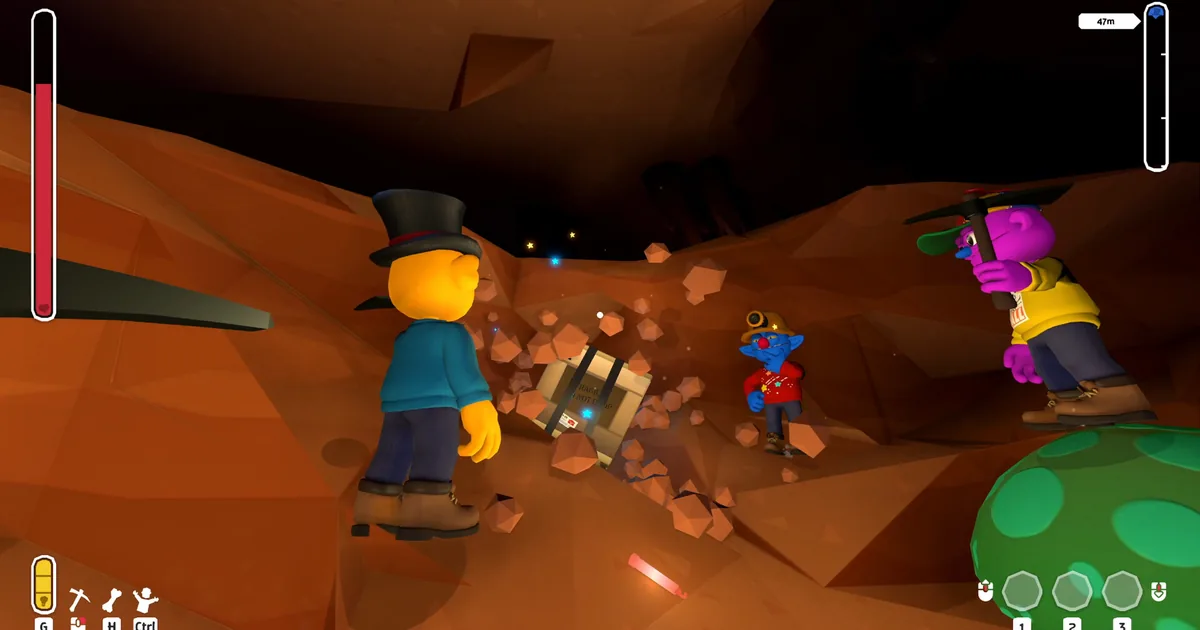
Bombs are throwable explosives. Damage terrain and any player in the blast radius. They are the single most chaos-creating item in Pratfall.
Legitimate uses:
- Clear large blocks of terrain faster than pickaxe or drill
- Blast through walls when you've identified a chest behind impassable rock
- Trigger environmental cascades (knock loose ceiling sections, drop terrain into a pit)
- End-of-run "we're already dead" plays where the chaos is the point
Tactical uses against the cave (not your friends):
- Clear a chamber's hazards in one explosion
- Take down a structure that's blocking the crew's path
- Destroy a section the drill would take 30 seconds to clear
Pratfall's physics engine reacts to the explosion in detail. Ragdolls fly, terrain shifts, items get scattered. The cinematic value of a well-placed bomb is part of why the game has 95% positive Steam reviews.
Step-by-step: item priority when carrying limited slots
Pratfall doesn't show inventory limits prominently, but practically you can't haul every item from every chamber. When you're choosing what to carry forward:
- Helmet first if you don't have one — the safety floor it gives is nonnegotiable
- Pickaxe as your default tool slot — there's almost no run where it's not useful
- Glow sticks in any dark biome — coordination value compounds with crew size
- Magic beans if you're seeing vertical geometry — drop them otherwise
- Bombs if you're in late-run "we're going to die anyway" territory — drop them in conservative situations
- Drill as situational backup to pickaxe — useful in time-pressured sections
- Food — pick up when health is below 60%, skip when full
- Flares — same role as glow sticks in lit biomes; drop when stack is full
This priority shifts by biome and crew composition. Solo runs lean harder on helmet + pickaxe + food. Larger crews benefit more from glow sticks (everyone sees the marks) and bombs (reduced consequence per player).
Tips
Watch for buried items. The Steam description says items are "scattered and buried." If a cave chamber feels empty, dig the floor and walls — there's a non-trivial probability of buried pickups, especially near landmark geometry like pillars and arches.
Don't drill near chests. The drill's clearing radius can destroy chest contents. Pickaxe through anything within 2 blocks of a chest you want to loot.
Glow stick placement is a coordination skill. New crews waste glow sticks on places only the dropper can see. Place them where the crew's likely path goes, not where you happen to be standing.
Magic beans aren't a panacea. Some sections look like they need beans but actually have a hidden pickaxe path. Look for soft terrain (different texture, sometimes lighter color) before committing a bean.
Bombs are great team-killers. If chaos isn't the point, throw bombs into open chambers, not into the formation your crew is standing in. Pratfall's physics applies blast damage equally to friend and enemy.
Helmet uptime matters more than helmet acquisition. Once you have one, keep it on. The friction of equipping it before a fall and forgetting it afterward is where most preventable KOs come from.
Food spawns favor structured locations. When you're low on health and there's no food in the immediate area, head toward chamber landmarks (pillars, intersections, chest sites) rather than continuing the descent.
Frequently asked questions
See above FAQ section.
References
- Pratfall on Steam — official store page with item descriptions and the developer's loop summary
- Pratfall WeMod trainer — confirms the in-game canonical name "Glow Sticks" (vs marketing "flares")
- Pratfall multiplayer guide — co-op fundamentals before items become useful
- Pratfall tips guide for beginners — physics, ragdoll, and biome basics
- Pratfall biomes breakdown — Dirt, Ice, and Lava Cave tactical differences
- Pratfall more players mod guide — what mods are (and aren't) available for Pratfall
- Pratfall complete guide — max players, more-players mod, items, biomes, and all gameplay guides
Was this guide helpful?
About the author

Indie & JRPG Critic
Indie game evangelist and lifelong JRPG fan covering small studios since 2017. Mumbai-born, London-based. Writes the way she talks.
- 7 years indie games coverage
- JRPG and visual novel specialist
- Narrative design focus


Disclaimer
This article is published for informational and entertainment purposes. It does not constitute professional financial, legal, or technical advice. Game performance, online services, patch schedules, and store listings change. Verify critical details (pricing, system requirements, regional availability) with publishers and storefronts before you buy. Affiliate links, where present, help support our editorial work and are labelled in our affiliate disclosure.