
GameBrief · General
Beastro Tips: 9 Things to Know Before You Start Cooking
Reviewing
Beastro
Timberline Studio
These Beastro tips cover what the game barely explains. Beastro launched June 11, 2026 to Very Positive reviews on Steam, and the pitch that hooked most players, cook meals for brave adventurers whose decks you directly shape through the kitchen, is exactly as clever as it sounds. The game barely explains how it works.
TL;DR: Cook for your Caretakers, match their preferred flavors, and build a two- or three-flavor plan while you learn the card system. Ingredient gathering and cooking shape the deck used beyond the village walls. The trick-taking combat borrows from Spades and Hearts, while exact timing and day-cycle rules should be checked in-game rather than assumed from an unofficial guide.
The cooking mini-games are intuitive. The farming loop is familiar. But the link between what you chop tonight and what cards appear in tomorrow's battle? That connection hides in the background until you start wondering why one Caretaker's run went so much smoother than another. What follows is what the game doesn't bother to tell you in the first few hours.
Beastro tips: the flavor system is your whole toolkit (quick answer)
Beastro's confirmed flavor roster is five suits: Salty, Bitter, Sweet, Sour, and Umami. Cooking turns ingredient choices into cards, so the best beginner plan is to follow the Caretaker's requests and build a focused but flexible flavor mix.
Current status: September 2026
Beastro launched on June 11, 2026 at a $19.99 list price. Steam currently lists 42 achievements and a Very Positive overall rating, while recent review percentages can move as more players review the game. Official launch and developer coverage confirm the five core flavors, cooking-driven deck building, Caretaker expeditions, and Game Pass availability. The latest official patch notes located were version 1.0.6, which addressed chapter quests, keyword descriptions, Kalan and Spirit issues, Sweet Boss behavior, and combat or minigame bugs. See the Beastro complete guide hub and Beastro release guide for the wider system map.
Step-by-Step: build your first Beastro deck
1. Read the request: Start with the Caretaker's stated preference and the flavor on the ingredients you already have. Treat the request as a direction, not a demand to discard every other option.
2. Cook for a clear plan: Choose ingredients that give the meal a coherent flavor profile. The developer describes each ingredient as part of the card system, so inspect the resulting card instead of judging the raw ingredient alone.
3. Test the card effects: In combat, compare number values with flavor interactions and read any effect text. The official examples include sleep, card removal, and strengthening your own flavor strategy.
4. Adjust after the run: Use the next meal to correct the weakest part of the deck. If the cards are too narrow, add a second flavor; if the deck lacks a clear identity, stop adding unrelated ingredients.
Beastro runs on five flavors: Salty, Bitter, Sweet, Sour, and Umami. They function as both the game's worldbuilding foundation and its card-suit system in combat. Ingredients carry flavors, dishes produce a flavor profile, and that profile shapes the deck your Caretaker takes beyond the village walls.
Think of flavors the way you'd think of suits in a trick-taking game like Spades. When you face a monster with a heavy Salty flavor, you can play a Salty card to match it, play a neutralizing card from a contrasting flavor, or boost your own suit to overwhelm it through raw power. The Xbox Wire launch article from Timberline Studio framed it simply: "sometimes you won't win by countering your opponent, but you'll win by strengthening your own strategy instead."
Don't stress about building a counter-deck to every monster type. A deck that's deeply good at one or two flavors will outperform a spread-thin generalist deck in most encounters. Specialization comes naturally once you figure out each Caretaker's preferred tastes.
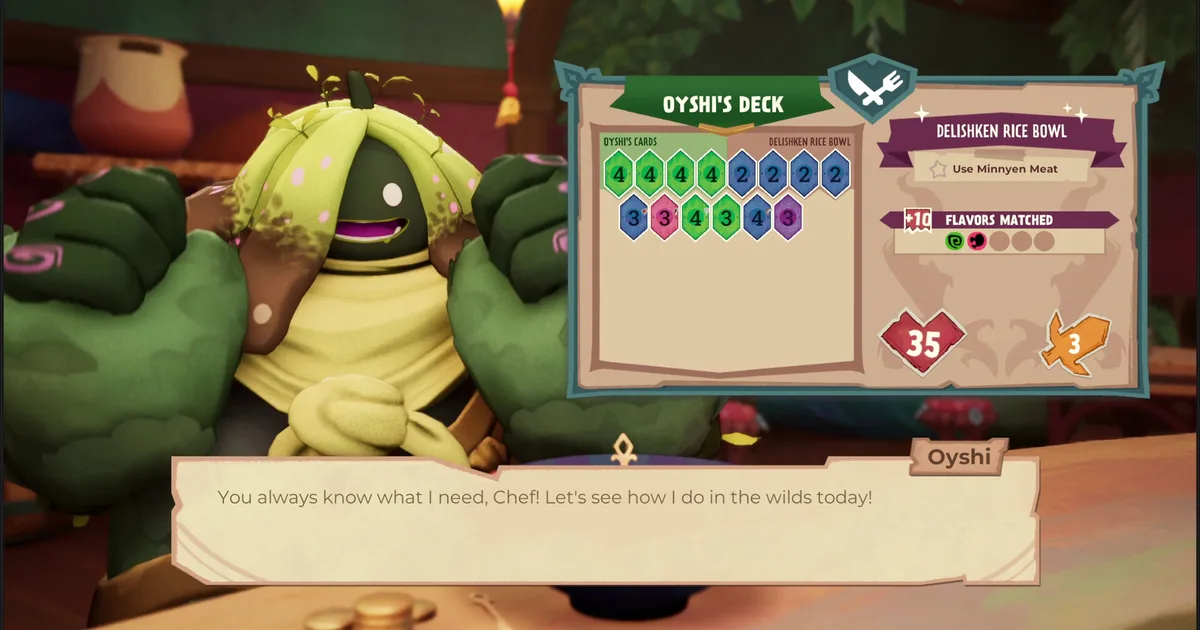
 The cooking interface shows the current request and deck context; use the in-game preview to confirm what a meal adds.
Match Caretaker preferences before worrying about cards
Each Caretaker comes from a flavor region, and that origin shapes what they like to eat. Oyshi is identified as the Umami Caretaker, while Kalan is the Bitter Caretaker. Their requests and story scenes are the safest signals for what to cook next, so use the Beastro deck building guide when you need to compare the resulting cards.
The Timberline Studio director described the core challenge well in a PlayStation Blog interview: "As the chef, it's up to you to balance their desired flavors and the magic you think they'll need to be successful in the wilds." That balance is the real puzzle. A meal that perfectly satisfies Oyshi's Umami preference will boost her spirits and unlock stronger card abilities. A meal that ignores her preferences fills her belly but does less for her deck.
Early on, you won't know every Caretaker's exact preferences. Pay attention to what they ask for when they arrive at the restaurant. The patron requests that show up during service are your clearest signal. When a Caretaker asks for something specific, prioritize it even if it means a slightly weaker flavor combination on paper. Satisfied Caretakers unlock abilities you can't get by ignoring their tastes.
GODEEPER: Black Jacket uses a similar card-suit logic but builds decks through encounters instead of cooking. Black Jacket Deck Building Guide: Best Suits and Combos 2026 →
Don't skip the skill tree in the first two days
Beastro has a cooking skill tree that sits quietly in the background while you're distracted by ingredient management. Newer players often leave it untouched for the first few in-game days because the cooking mini-games feel manageable without upgrades.
The skill tree can unlock new meals and cooking know-how. Xbox Wire's launch coverage says players can develop new meals and progress their know-how through a skill tree. Treat the exact timing-window or card-number effects of individual upgrades as in-game observations unless the tooltip confirms them.
Check the skill tree after your first Caretaker run, not after three or four. Some upgrades are gated behind story progression anyway, but the cooking-focused ones are available almost immediately.
Card effects matter more than numbers past the first zone
Community discussions often recommend adding card effects once encounters become more demanding, but the official material does not establish a universal second-zone rule or a named Mogave Desert breakpoint.
Each card in your Caretaker's deck has two attributes: a number value and a flavor suit. Most players in the first zone win tricks based on number alone. Higher number beats lower number, same as in any trick-taking game. But some cards have special effects: putting enemies to sleep, blowing away an opponent's card before it resolves, or caramelizing a Sweet-suit card for a bonus when fire appears in the battle environment.
The official guidance from Timberline is worth quoting directly: "some cards have effects that can create new opportunities and open up new ways to build your deck. They aren't essential, but they can help your Caretakers when they're beyond the walls." Use that as a decision rule, not as a promise about a particular zone or boss.
When you're cooking and choosing ingredients, start glancing at what effect each ingredient's card unlocks, not just its flavor and power level. A Bitter ingredient with a sleep effect might be more valuable than a Sweet ingredient with a higher power number, depending on what your Caretaker faces next.
Use new ingredients deliberately
When Caretakers return from expeditions, new ingredients can expand your cooking options. Treat rare ingredients as a resource to evaluate, not an automatic emergency button, and check what card they create before spending them.
Do not hoard an ingredient just because it sounds rare, but do not assume it expires either. Use it when its flavor or card effect fits the next expedition, and keep a backup plan for a Caretaker whose request points in another direction.
The exception is deliberate pairing: save an ingredient when its card effect clearly complements a Caretaker's current plan. The exact value of that pairing is run-specific, so rely on the card preview rather than a fixed day-count rule.
 This supplied screenshot shows the cooking minigame, not the separate puppet-theater combat presentation.
The cooking mini-games reward specific timing, not speed
Beastro's cooking sequences cover chopping, sauteing, pan flipping, and assembly. The official coverage confirms several cooking minigames, while the exact scoring rules for each action should be read from the current build rather than generalized from one minigame.
The cutting sequence rewards attention, but the sources checked for this audit do not confirm a universal multiplier, reset rule, or no-timer promise. Watch the feedback on each action and follow the current tooltip or tutorial.
For new players: slow down and learn the feedback. The exact day-cycle and timing rules are not documented in the authoritative sources reviewed here, so avoid planning around an assumed infinite timer or a fixed chopping multiplier.
Balance your ingredient sources early
Beastro gives you three main ways to gather ingredients: farming (plant, water, harvest on your land), fishing, and foraging in the areas around Palo Pori. Each source produces different flavor profiles, and relying too heavily on one will push your Caretakers' decks toward that flavor whether you intend it or not.
In the first two or three in-game days, make a habit of doing at least a short forage run even when your garden has enough produce. Foraged ingredients often carry Sour or Umami flavors that farming doesn't produce easily, and they tend to appear earlier in the game than fishing unlocks. That variety keeps you prepared when a Caretaker arrives with unusual preferences.
Xbox Wire's launch feature mentioned that "you can grind it out if you prefer, or you can spend more time investing in your farming, planting or cooking techniques to improve the cards you have already." Both approaches work. Rotate ingredient sources and spend time on skill upgrades when the current deck feels narrow, but treat any zone-specific wall as editorial advice rather than a fixed rule.
GODEEPER: If you're drawn to the deck-building side of Beastro, Die in the Dungeon uses a similar philosophy: every run is shaped by what you bring in. Die in the Dungeon Best Build: Attack, Poison, and Reroll →
Don't forget to customize the restaurant
Beastro lets you upgrade the restaurant's decor to increase its appeal to patrons. It's the system most new players ignore for the first few days, because the cooking and combat loops grab attention faster. But appeal isn't cosmetic. A higher-appeal restaurant pulls in a wider range of patron types, which means ingredient requests you wouldn't otherwise see and flavor combinations you'd never think to try.
Early upgrades through the village's merchants and blacksmiths also unlock new cooking tools and ingredient handling options. The blacksmith in Palo Pori is worth visiting after the first expedition results come back. Some tool upgrades directly affect mini-game timing windows, which circles back to the cutting combo point above.
Restaurant appeal also influences which Caretakers stop by and how willing they are to reveal their preferences. A low-appeal eatery early on isn't punishing, but pushing appeal up before the second major story beat smooths out the middle section of the game considerably.
Frequently Asked Questions
What are the five flavors in Beastro? Salty, Bitter, Sweet, Sour, and Umami. The developer calls these the five core flavors, and they also function as the card-suit system.
How do I build a strong deck in Beastro? You build the deck through cooking, not combat. Each ingredient you use in a meal unlocks a card for that Caretaker's combat run. Match the Caretaker's preferred flavors to unlock better abilities. Early on, keep a mixed deck of two or three flavors rather than going mono-flavor.
Who are the Caretakers in Beastro? Caretakers are adventurers who eat at your restaurant and then venture beyond the village walls to fight monsters. Oyshi is the Umami Caretaker, a gentle character with a natural affinity for animals. Kalan is the Bitter Caretaker, a solitary figure who resists help but can be won over through discovering his favorite dishes.
How does combat work in Beastro? Combat uses trick-taking mechanics borrowed from card games like Spades and Hearts. Cards display a number and a flavor suit. You can match an opponent's flavor magic, neutralize it with a balancing card, or enhance your own flavor with a boosting card. Some cards have special effects like putting enemies to sleep or blowing away cards.
Do I need to rush through each day in Beastro? The official sources reviewed for this guide do not publish enough detail to promise a no-timer daily cycle. Learn the current build's day phases and use the cooking preview before committing ingredients.
Can I use expedition ingredients as cooking ingredients? The game supports multiple ingredient sources, including expeditions, farming, fishing, and foraging. Check each item's current description for its flavor and card result instead of assuming all rare ingredients behave the same way.
Is Beastro difficult for players who don't like card games? Beastro is designed to be approachable. The card system draws from traditional trick-taking games rather than complex roguelike deckbuilders, so the rules are simpler. You can also grind through ingredient farming and cooking improvements without optimizing every card, making it accessible even if you usually avoid the genre.
Related Reading
- Beastro Complete Guide: Flavors, Decks, Caretakers 2026: the full hub linking every Beastro guide on this site.
- Beastro Release Date: Cooking Deckbuilder Hits June 11: launch date, platforms, and Game Pass details.
- Black Jacket Deck Building Guide: Best Suits and Combos 2026: another suit-based deck construction system.
- Die in the Dungeon Best Build: Attack, Poison, and Reroll: more deck-building paths after Beastro.
- Sunderfolk Beginner Guide: Best Classes and Party Tips: a friendly 2026 indie with deeper systems.
- Best Indie Roguelites on Steam 2026: where Beastro fits among indie roguelites.
- Tales of Seikyu Tips: 9 Things to Know Before Year 1: another cozy title built around experimentation.
- Beastro Deck Building Guide: Best Cards and Combos 2026: how cooking choices shape cards.
- Beastro Review: A Cozy Deckbuilder Worth Your Time: the full review and current reception context.
References
- Beastro on Steam. Official store page: $19.99 list price, 42 Steam achievements, and a current Very Positive overall rating whose percentages and counts change over time.
- Beastro: A crunchy-cozy deck builder. PlayStation Blog feature with developer quotes on Caretaker flavor preferences and the mise en place cooking system.
- How Beastro is Cooking Up a Stew. Xbox Wire developer interview covering the trick-taking card system, ingredient gathering, and skill tree progression.
- Beastro Launches on Game Pass. Xbox Wire launch coverage with official beginner tips on flavor balance and card effects.
- Beastro official Steam announcements. Launch and patch notes, including the 1.0.6 fixes checked for this audit.
Was this guide helpful?
About the author

Indie & JRPG Critic
Indie game evangelist and lifelong JRPG fan covering small studios since 2017. Mumbai-born, London-based. Writes the way she talks.
- 7 years indie games coverage
- JRPG and visual novel specialist
- Narrative design focus
Keep reading





Disclaimer
This article is published for informational and entertainment purposes. It does not constitute professional financial, legal, or technical advice. Game performance, online services, patch schedules, and store listings change. Verify critical details (pricing, system requirements, regional availability) with publishers and storefronts before you buy. Affiliate links, where present, help support our editorial work and are labelled in our affiliate disclosure.
Comments
Loading comments…