GameBrief · General
Fatekeeper Tips: 11 Things to Know Before You Start

Reviewing
Fatekeeper
Paraglacial · THQ Nordic
These Fatekeeper tips exist because the game launched June 2, 2026 with strong reviews and a first boss fight that ended a lot of early access sessions before hour two. The community figured it out the hard way. Here's what actually matters in the current build.
TL;DR: Dash is not optional. Telekinesis is the best early spell school pick because it counters archers directly. Don't go full magic before beating the Minotaur boss (Derelict Waterways). No difficulty slider exists. Focus one enemy to zero before switching targets. Weapons break, so carry a backup.
Fatekeeper tips: what to know before your first fight (quick answer)
Three facts that change how you approach the game from minute one:
Dash is a core mechanic, not a bonus. The combat community's consensus is that the game is "pretty much unplayable" without it. Every fight involving multiple enemies or a ranged threat will punish you repeatedly if you treat dash as optional.
No difficulty slider exists. The reactive melee system IS the difficulty curve. If a section feels overwhelming, the fix is usually build adjustment or learning a specific enemy telegraph pattern, not lowering a setting.
Ranged archers are the biggest early threat, and Telekinesis exists specifically to deal with them. Investing there first changes the early game substantially.
Key takeaways
- Dash is your primary survival tool; use it early and often, understand its stamina cost
- Telekinesis counters ranged enemies at close range: pull, drag into traps, yank for free attack windows
- The first boss (Minotaur, Derelict Waterways) has been patched and is now more reasonable than launch
- Full magic builds struggle vs the Minotaur specifically; hybrid melee remains the safer first-run path
- Skill tree investments lock you in early, so pick a direction before committing points
- Weapons break, carry a backup before any tough encounter
- Focus one enemy to zero before engaging a second
Overview: Fatekeeper's combat system
Fatekeeper's combat takes obvious inspiration from Dark Messiah of Might and Magic: physics interactions, environmental kills, and melee that rewards timing and spacing over spam. The difference is the spell school system layered on top.
Six spell schools exist in the current build: Telekinesis, Fire, Wind/Gust, Shatter, Ice, and Life Leech. Each works differently in a fight. Melee underlies all of them. Understanding where each school fits is the foundation for the Fatekeeper tips that follow.
The game is linear. You're not exploring an open world but moving through handcrafted areas, each leading to the next narrative beat. That linearity means the game can throw specific enemy types at you knowing exactly what you've encountered before, so the difficulty curve is intentional.
 Fire school covers range when standing in melee isn't safe: the tight corridor is exactly where the melee-plus-Fire rhythm shows its value.
GODEEPER: For a full look at whether the combat system earns the price at this stage of Early Access, see the full review. Fatekeeper Review: 2 Hours Now, 15 Hours at Launch →
Step-by-step: how to approach your first area
Before the Minotaur boss, the game teaches the core loop without tutorial screens. Here's the mechanical sequence that actually sticks:
Step 1: Enter a room, stop, and look for archers first. Archers on ledges or at distance will ruin any melee approach. Scan high ground before committing to a forward advance.
Step 2: Use Telekinesis to pull ranged enemies into melee range. The pull animation stuns briefly and creates a free heavy attack window. This is the specific mechanic that makes Telekinesis worth its first spell school investment.
Step 3: Dash through incoming attacks, not away from them. Dashing backward puts you against walls and limits options. Dashing through an attack arc moves you into the enemy's back, which opens a brief vulnerability window for every melee class.
Step 4: Equip relics at save points, not in a panic mid-area. Relics are equipped at save points only. Plan your relic loadout before entering a difficult section rather than discovering you forgot to equip the Heart of the Phoenix before a boss.
Step 5: When you die, check what hit you last. The game has no death recap, but the pattern is usually one of three things: a ranged archer you didn't prioritize, an unblocked heavy you didn't dash through, or stamina exhaustion from over-dashing.
Fatekeeper tips: the 11 things that matter
1. Dash is not a dodge roll. It's mandatory movement. Players new to physics-based first-person melee often treat dash as an emergency button. In Fatekeeper, it's the spacing tool that makes the whole combat system work. Use it to close distance, interrupt recovery windows, and reposition around attacks. If you run out of dash in a group fight, back off immediately.
2. Telekinesis is the best first spell school investment. It doesn't deal the most damage. It counters the most dangerous enemy type in the early areas: ranged archers. Pulling an archer off a ledge, dragging it into a pit, or yanking it forward for a free heavy attack removes threats that would otherwise require dangerous repositioning. Treat it as a utility investment, not a damage one.
3. The Minotaur boss (Derelict Waterways) was patched. At launch this fight ended a lot of early access sessions. The first patch adjusted it significantly. If you're playing now, the version you face is the patched one: still punishing, but learnable. The key mechanic: dodging works, spacing works, and a full melee build makes it considerably easier than a pure magic spec.
4. Full magic builds struggle with the first boss. One player who ran a zero-skill-points challenge put it plainly: "if someone has all their points in magic, that's basically the same thing as having zero skill points as far as this boss goes." The Minotaur requires sustained melee pressure and sustained movement. Keep at least a modest melee investment for your first run, and add spells on top of it.
5. The skill tree locks you in early. Choose with intent. Community feedback flags that the skill tree pushes you down a single path fairly quickly. Before spending your first few points, decide whether you're building around melee speed, melee damage, or a specific spell school. Spreading points too broadly in the early build leaves you effective at nothing.
6. Weapons break. Carry a backup. This surprises people. Weapons in Fatekeeper can break, particularly older or lower-quality ones. Before a boss run, check your equipped weapon's condition and keep a secondary in inventory. Starting a boss fight with a weapon at low durability is an avoidable death.
7. Focus one enemy to zero before touching the next. Multiple enemies at once is where most players lose runs they should win. An enemy at zero health can't attack you. An enemy at 60% health absolutely can, and will. Kill the closest, move to the next. Don't split damage across two targets thinking you're making progress on both.
8. Fire covers the gap when melee is too risky. The melee-plus-Fire build works because of how the pacing alternates: close, strike, back off, fire at range to deal chip damage while the enemy recovers. Fire doesn't require positioning the way Telekinesis does. It's the most straightforward secondary school for melee-focused builds.
9. Read the telegraph before committing to an attack. The game is reactive, not spammy. Every enemy has a wind-up before a heavy attack. Trading hits without reading the animation is the most common way to die in the early hours. The window to attack safely is after a wind-up, not during or before.
10. Relics at save points, not mid-combat. Equipped at save points only. Heart of the Phoenix (2% health regen on crit) is the default sustain relic for crit-leaning builds. But the most important Fatekeeper tip about relics is simply to remember to equip them before a hard section. Players routinely forget and run boss attempts without any relic active.
11. The 2-hour build is a sandbox for build learning, not a full game. Second playthrough to try a Shatter-focused spec takes 90 minutes. That's the hidden upside of the short current content: the cost of getting a build wrong and starting over is genuinely low. Use it. The mechanics you're learning now carry into the full 15-hour release.
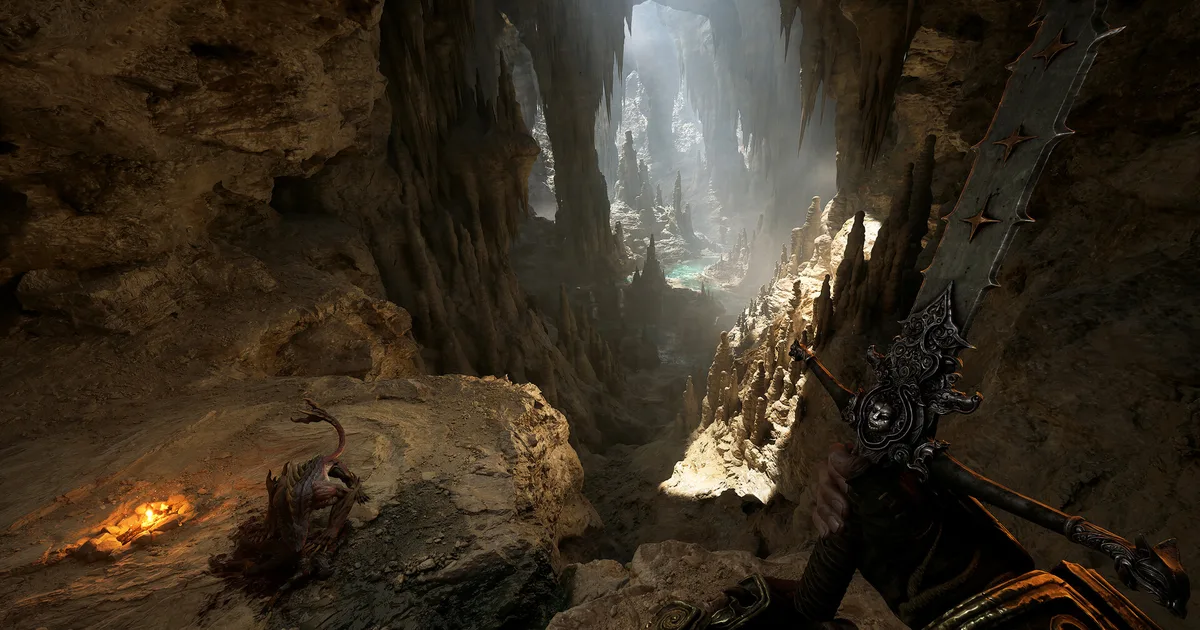
 Fatekeeper's handcrafted areas commit to linearity: each section leads to the next encounter. The 2-hour build is short enough to replay with a completely different spec.
GODEEPER: For a full breakdown of each build path including which relics to pair with melee, Fire, and Telekinesis specs, see Fatekeeper Best Build: Melee, Fire, and Caster Routes →
Frequently Asked Questions
Is there a difficulty option in Fatekeeper? No. Fatekeeper has no difficulty slider in the current Early Access build. The reactive melee system and enemy placement are the difficulty curve. If you're struggling, adjust your spell school investment and make sure you're using dash regularly.
What spell school should I pick first in Fatekeeper? Telekinesis is the highest-value first pick. It lets you pull ranged enemies off ledges, drag them into pit traps, and yank them toward you for a free heavy attack window. Archers are the biggest early threat.
Is the Minotaur boss nerfed? Yes. The first patch after launch adjusted the Minotaur in the Derelict Waterways. It's still a demanding fight but considerably more reasonable than launch. A hybrid melee build makes it much more manageable than a pure magic spec.
Does Fatekeeper have breakable weapons? Yes. Check weapon durability before boss runs and carry a backup.
How long is Fatekeeper right now? The current Early Access build runs approximately 2 hours per the developer. Paraglacial targets 15 hours for the full release, with an estimated 18-month Early Access window from the June 2, 2026 launch.
What is Fatekeeper's price? Fatekeeper launched at $7.99 as an introductory price. The standard price is $9.99, and Paraglacial has stated the price will increase further as more content arrives.
Related Reading
- Fatekeeper Best Build: Melee, Fire, and Caster Routes: Three full build paths for the current Early Access build, with relic pairings and attribute priority order.
- Fatekeeper Review: 2 Hours Now, 15 Hours at Launch: Full review of the current build, covering gameplay, spell schools, and whether $7.99 is worth it.
- Fatekeeper: What It Is, What You Get, and Is It Worth It: Overview article covering developer background, genre, and the Early Access roadmap.
- Early Access Games Worth Buying Right Now in 2026: How Fatekeeper compares to other Early Access RPGs and when to buy vs. wait.
References
- Fatekeeper on Steam: Steam store page, including developer notes, roadmap, and review summary.
- r/fatekeeper community discussions: Community tips, build discussions, and boss strategies referenced in this guide.
- Fatekeeper Early Access launch trailer: Official gameplay trailer via THQ Nordic.
Was this guide helpful?
About the author

Indie & JRPG Critic
Indie game evangelist and lifelong JRPG fan covering small studios since 2017. Mumbai-born, London-based. Writes the way she talks.
- 7 years indie games coverage
- JRPG and visual novel specialist
- Narrative design focus


Disclaimer
This article is published for informational and entertainment purposes. It does not constitute professional financial, legal, or technical advice. Game performance, online services, patch schedules, and store listings change. Verify critical details (pricing, system requirements, regional availability) with publishers and storefronts before you buy. Affiliate links, where present, help support our editorial work and are labelled in our affiliate disclosure.