
GameBrief · General
Wax Heads Tips: Research, Records, and RAD! Ratings
Reviewing
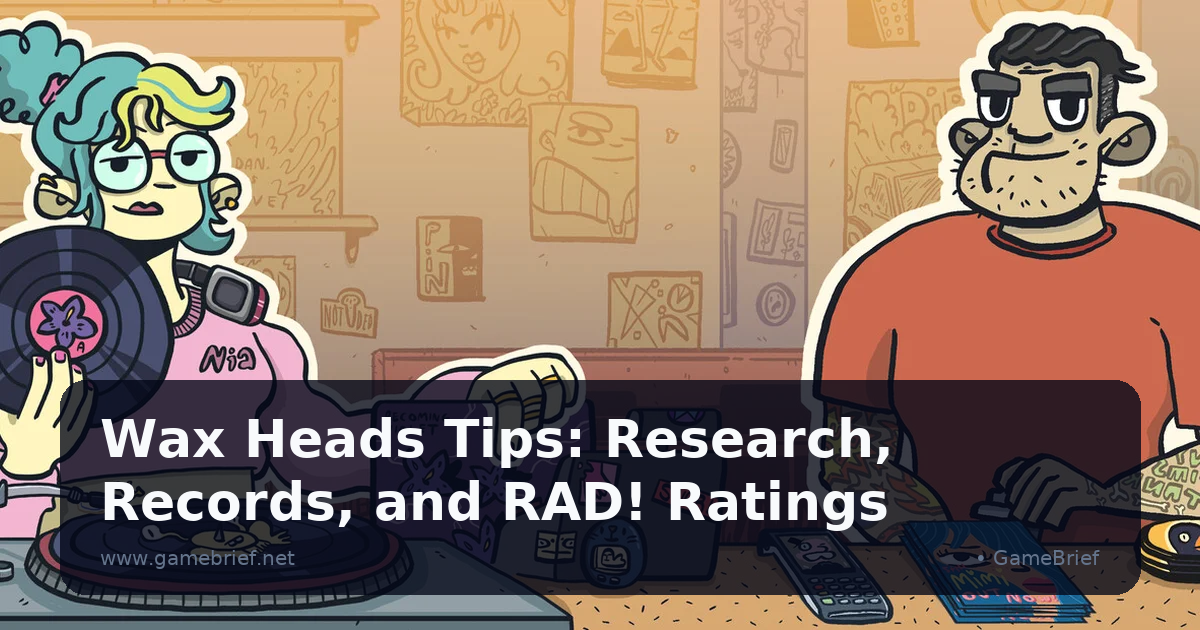
Wax Heads
Wax Heads tips matter most in the first two hours, before the research tools feel intuitive. The shop waits for you: there's no timer pressing a bad recommendation. But you can still fail through inattention: recommending before you fully understand the customer, skipping Phonogram, not reading liner notes, or treating repeat visitors like blank slates when their conversation history tells you something.
This guide covers how the recommendation system works, how to layer the research tools in the right order, and where most players make the same few mistakes.
TL;DR: Wax Heads has no time limit: the shop waits while you research. Use Phonogram first (band's social presence reveals tone and aesthetic), liner notes second (confirms or contradicts the Phonogram read), and conversation history for any returning customer before they finish speaking. RAD! comes from matching the customer's specific emotional language, not just genre. The game has 80+ albums across 19 in-game tracks; a full run is 4-6 hours.
How do you succeed at Wax Heads? (quick answer)
- No time pressure: customers at Repeater Records wait while you dig through research. Speed is never the goal; accuracy is.
- Research tools work in a priority order: Phonogram feed first, liner notes second, conversation history for returning customers.
- RAD! ratings come from specific matching. MEH means close but something was off. SAD means you missed a constraint the customer communicated clearly.
- Wait for the full customer description before touching your research tools. The second and third sentences narrow the field significantly.
- The 80+ albums aren't interchangeable. Each has a distinct mood, era, and energy identity you need to understand before you can match it reliably.
Overview: How the Recommendation System Works
Wax Heads puts you behind the counter at Repeater Records, matching albums to customers based on mood, energy, and sonic preference. You don't see a numerical compatibility score: you get conversation. A customer says they want something melancholy but danceable. Another asks for music that sounds like driving at 2 a.m. You research and recommend.
The rating comes back immediately as RAD! (great match), MEH (acceptable but off), or SAD (mismatch). These aren't grades. They're the customer's honest reaction. Getting a SAD means you missed something specific they communicated, not that the album itself is bad.
What makes the system unusual is that the game actually waits while you research. Open Phonogram, read liner notes, check conversation history from previous visits: none of it costs you time with the customer. The orientation problem most players hit in the first hour isn't pressure, it's not knowing which tool to open first.
 Customer preferences are tracked across sessions: early dismissals come back around.
The Phonogram Feed
Phonogram is the in-game social platform for the fictional music world, somewhere between Instagram and Bandcamp for the game's invented bands. Every artist has a presence there. The posts tell you tone and aesthetic, the kind of imagery they use, and whether the band reads as contemporary, retro, or genre-specific.
Phonogram is the first tool to open when a customer gives you an abstract description. "Something that sounds like winter" or "music for someone who gave up but isn't angry about it": these map to Phonogram aesthetics. The posts have a voice that corresponds to the album's actual feel.
One thing the game doesn't explain: Phonogram is indexed by band, not by genre. If you don't know which bands fit a vibe, start with albums you already know and check their pages first. The right album's Phonogram feed will confirm the match. The wrong one feels tonally off even in the posts.
Reading Customer Cues
Customers describe what they want in layers. The first sentence is the surface read. The second and third, if you wait, give you the actual constraint.
The surface might be "something upbeat." Two sentences later: "but not something I'd hear in a coffee shop." That narrows the field: upbeat and distinct, not background-friendly pop. Two completely different shortlists.
Wait before you go to the albums. The customers don't rush out. If you let the conversation develop, they often give you a detail that cuts your research time in half. Recommending after the first sentence is how you earn MEH ratings on records that were technically close but missed the specific feeling they communicated.
GODEEPER: The customer matching mechanics and how the game tracks your history with repeat visitors are covered in detail in the full guide. Wax Heads Customers and Records Guide →
 Stock balance matters more than price: running out of a genre costs repeat customer trust.
Liner Notes and Magazines
Every album in Repeater Records has a physical sleeve with liner notes. These include:
- A short statement from the band, written in the voice of the music itself
- Credits that reveal instrumentation and production style
- Mood tags or thematic notes that don't always appear in Phonogram posts
Liner notes are the confirmation layer. After Phonogram points you toward a likely match, the liner notes verify it. Specifically, they tell you whether this particular album matches the band's Phonogram persona or whether it's an outlier in their catalog. Some artists release records that don't match their social tone. The liner notes surface that.
Magazines in the shop contain reviews and interviews. Slower to read than liner notes, but the framing is useful: "this record works for people who..." maps directly to abstract customer requests. When Phonogram and liner notes both feel close but you're not sure, a magazine piece will often break the tie.
Step-by-Step: Building a RAD! Rating
These Wax Heads tips for getting consistent RAD! results come down to the same five steps every time.
Step 1: Let the full description land
Don't reach for research after the first sentence. Let the customer finish, then wait another beat. Write down (mentally or literally) the exact words they used. "Melancholy but warm" is different from "melancholy." "Something I could run to" is a different ask than "upbeat."
Step 2: Build a shortlist before opening Phonogram
After a few hours with the game, you'll know the 80+ albums by general feel. Narrow your shortlist to three to five candidates based on the customer's description. Then open Phonogram for each. You're looking for the one whose social presence matches what they described.
Step 3: Check liner notes on the frontrunner
Once Phonogram points to a likely match, open the album sleeve. If the liner notes introduce themes that don't fit what the customer said, cross that album off and go back to your shortlist.
Step 4: Review conversation history for repeat visitors
If the customer has been to Repeater Records before, check their history tab before recommending. Prior recommendations, their reactions, things they mentioned in earlier visits: all of it filters your current read. A past RAD! tells you what direction worked. A prior SAD tells you what to avoid entirely.
Step 5: Recommend
When research confirms the match, hand over the record. The rating is immediate. If it's MEH or SAD, read the reaction: they usually say what felt wrong. That's direct feedback for the next customer with a similar request.
Wax Heads Tips for Difficult Customers
Customers who describe what they don't want
Some visitors define their request entirely in negatives: "not aggressive," "nothing my dad would like," "not too sad." These are filter constraints, not directions. Cross off the eliminated categories first, then research within what's left. Phonogram is more useful here than liner notes. The tone of a band's social presence tells you whether they'd register as too aggressive or too familiar faster than any liner note will.
Customers with contradictory signals
"Old but not nostalgic" or "simple but not boring" describes a tension, not a contradiction. These usually map to albums with one quality on the surface and something else underneath. Phonogram feeds for these bands tend to be understated rather than loud. Check liner notes more carefully. The apparent contradiction in the request is often resolved in the album description.
Returning customers whose taste shifted
A customer's preferences can change across visits. If their history shows a consistent pattern but the current request sounds different, trust the current request. History helps when the current description is vague: don't let prior patterns override explicit new signals. The history tab is context, not a script.
GODEEPER: Wax Heads launched May 5 and holds a Very Positive rating (96%, 387 reviews) on Steam: the review covers whether the emotional arc of the narrative earns that score. Wax Heads Review →
Common Mistakes
Most Wax Heads tips fail not because the advice is wrong but because players skip steps under imaginary pressure. Here's what actually goes wrong.
Recommending too fast
The most common cause of SAD ratings. There's no cost to spending five minutes on Phonogram before handing over a record. The shop waits. Rushing through to maintain some imaginary momentum consistently produces worse outcomes than taking time to confirm the match.
Treating Phonogram as optional flavor
Phonogram isn't ambient content. Every artist in the game has a social presence because it's the primary research tool for understanding how an album sounds before you've heard it in context. Skipping it and relying on album titles and sleeve images alone produces inconsistent results across the shift.
Ignoring returning customer history
The conversation history tab exists because it matters. A customer who's visited three times has given you information across those interactions. Checking their history before they finish speaking, even before they ask, gives you context that changes how you interpret what they're saying now.
Researching obvious answers
Not every recommendation needs Phonogram. Some customers say something direct. "I want the saddest record in the store" doesn't require fifteen minutes of research. Know when the answer is clear and move. Over-researching an obvious case doesn't improve the outcome; it just delays it.
Frequently Asked Questions
Is there a timer in Wax Heads? No. Customers wait while you research. There's no time pressure on individual recommendations: the store literally pauses. The game measures match accuracy, not speed. Taking time to research correctly always produces better outcomes than guessing quickly.
What's the difference between MEH and SAD ratings in Wax Heads? MEH means the recommendation was acceptable but missed something in what the customer expressed. SAD means a clear mismatch: usually from ignoring a specific constraint the customer communicated clearly. MEH customers leave neutral; SAD customers leave disappointed. Both give you feedback you can use for next time.
How do you use the Phonogram feed in Wax Heads? Open Phonogram through the in-game interface and search for the band whose album you're considering. Read their posts for tone, visual aesthetic, and lyrical themes. The feed tells you how the band presents themselves publicly, which maps directly to how a specific listener type will hear the album.
How many albums are in Wax Heads? Over 80 hand-drawn albums, each with distinct cover art, liner notes, and a specific mood identity. The game includes 30+ original songs composed by Gina Loughlin. No two albums are interchangeable: each has a genuine identity you need to learn before matching it to customers reliably.
What platforms is Wax Heads on? PC (Steam) only at launch. The game launched May 5, 2026 and currently holds a Very Positive rating (96%, 387 reviews) on Steam. It's priced under $10, with a 15% launch discount at release.
Can you replay a recommendation you got wrong? No. If a customer gets a SAD, they leave and you move on. What you gain is their verbal reaction: they usually say what felt off. That feedback is how you calibrate for the next similar customer. There's no rewind mechanic, but wrong recommendations are also how you learn the album catalog.
Does the conversation history tab matter in Wax Heads? Yes, significantly. Returning customers have a history that records what worked, what didn't, and what they mentioned in past visits. Checking it before they finish speaking gives you context that changes how you interpret their current request. Ignoring it on repeat visitors is the most avoidable mistake in the game.
References
- Wax Heads on Steam: official store page, system requirements, current review score
- Curve Games (publisher page) studio and publishing information for Wax Heads and developer Patattie Games
Related reading
These Wax Heads tips focus on the research layer, but the Wax Heads customers and records guide covers the mechanics of the customer matching system in detail: how the game tracks repeat visitors and what their history reveals about preferences.
The Wax Heads review covers the full experience: whether the narrative arc earns its runtime and how the game compares to similar shop-sim releases.
If Dead as Disco's music-shop energy appeals to you in a different direction, the Dead as Disco guide covers its mechanics and structure in full.
Was this guide helpful?
About the author

News Reporter
Games journalist and news hound with 7 years covering industry moves, studio announcements, and patch notes. Chilean. Writes tight, edits tighter.
- 7 years games journalism
- Industry and esports specialist
- Early access coverage
Keep reading
Disclaimer
This article is published for informational and entertainment purposes. It does not constitute professional financial, legal, or technical advice. Game performance, online services, patch schedules, and store listings change. Verify critical details (pricing, system requirements, regional availability) with publishers and storefronts before you buy. Affiliate links, where present, help support our editorial work and are labelled in our affiliate disclosure.
Comments
Loading comments…