
Complete guideRune Dice
Rune Dice Complete Guide 2026: Classes, Relics, and Builds
Rune Dice complete guide covering all 8 classes, relic priority, unlock order, dice synergies, NG+, and tips. Hub for every Rune Dice guide on the site.
This Rune Dice complete guide covers the physics-based roguelike from Smart Raven Studio. Your dice don't just land: they bounce off walls, collide with each other, and trigger chain reactions depending on how the throw plays out. That physics layer is what separates Rune Dice from dice-based card games where outcomes are purely random. You have throwing skill. Positioning matters. And when a run clicks, it clicks because you made something happen.
This is the complete hub for every Rune Dice guide on the site. Use it to find specific articles or to get an overview of how the core systems connect.
TL;DR: Rune Dice has 8 officially listed classes, a physics-based throwing mechanic, and relics, runes, altars, and procedural maps that change a run. Steam currently shows 79% Mostly Positive from 1,266 reviews, 93% positive across 74 recent reviews, $14.99, and 34 achievements. The latest official updates add new unlockable items, bomb-build relics, Ward and Dispel, and new minibosses.
What is Rune Dice? (quick answer)
Rune Dice is a physics-based roguelike from Smart Raven Studio, published by Kwalee. It's available on PC, PS5, Xbox Series, and Nintendo Switch.
Each run is a series of encounters where you throw physical dice onto a board. Dice roll, bounce, and interact physically. Matching dice can fuse, and chain combos can seek matching values. Where they land and how they collide determines which magical effects trigger. You're not just selecting from a menu: you're throwing and watching chain reactions play out.
Between encounters, you buy relics and upgrade your dice pool at shops. The game has 8 classes, each with a distinct class identity, and the store also describes multiple heroes, bosses with unique abilities, runes, altars, and a procedural map. Use the current game menus for the exact unlock and mode state rather than assuming an older guide's condition still applies.
Rune Dice launched May 2026 from Smart Raven Studio with a demo available on Steam. The main run is completable in a few hours; relic variety and class unlocks drive replay.
The 8 classes
The official Rune Dice community page lists the complete class roster as Rogue, Warrior, Mage, Archer, Druid, Bard, Paladin, and Necromancer. The Steam store describes 8 unique classes with special dice or magical abilities and multiple heroes. That is the source-backed roster. It does not publish a complete class kit table or one permanent unlock order, so the summaries below use the class names as navigation and avoid presenting community guesses as rules.
Rogue, Warrior, Mage, Archer, Druid, Bard, Paladin, and Necromancer are the eight names to look for in the current class screen. Pick a class by the starting dice and special ability visible in your build, then use the first encounters to learn its throw behavior. A class guide can explain a plan, but the current tooltip is the authority when a patch changes a trigger or a starting die.
The practical difference between classes is the relationship between their starting dice, the physics board, and the relics or runes offered during the run. Some plans want reliable merges, some want a particular landing face, and some want repeated chain reactions. Do not convert that broad distinction into claims such as “this class is always the safest” or “that class is always the highest ceiling” without current data. The official pages confirm variety, not a universal tier list.
For unlocks, use the class panel and achievements together. The official achievement page has a “Class Explorer” achievement for unlocking five classes and a “Full Tavern” achievement for unlocking all classes. Those achievements verify the roster's progression shape, but they do not replace the current in-game conditions for an individual class. If a third-party guide gives a numerical trigger, check it against the installed version before repeating it.
For a playstyle discussion, the Rune Dice tier list is still useful as editorial opinion. Read its rankings as recommendations, not as official balance facts.
GODEEPER: S-to-B ranking for all 8 classes, best picks by experience level, and which classes scale into NG+. Rune Dice Tier List: All 8 Classes Ranked 2026 →
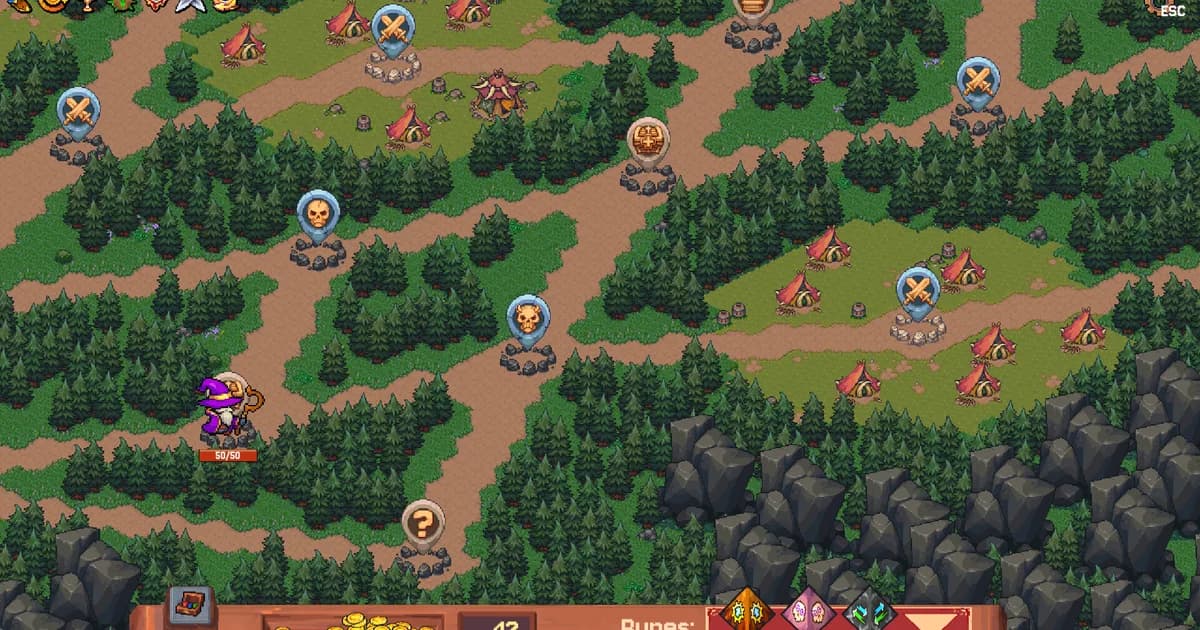
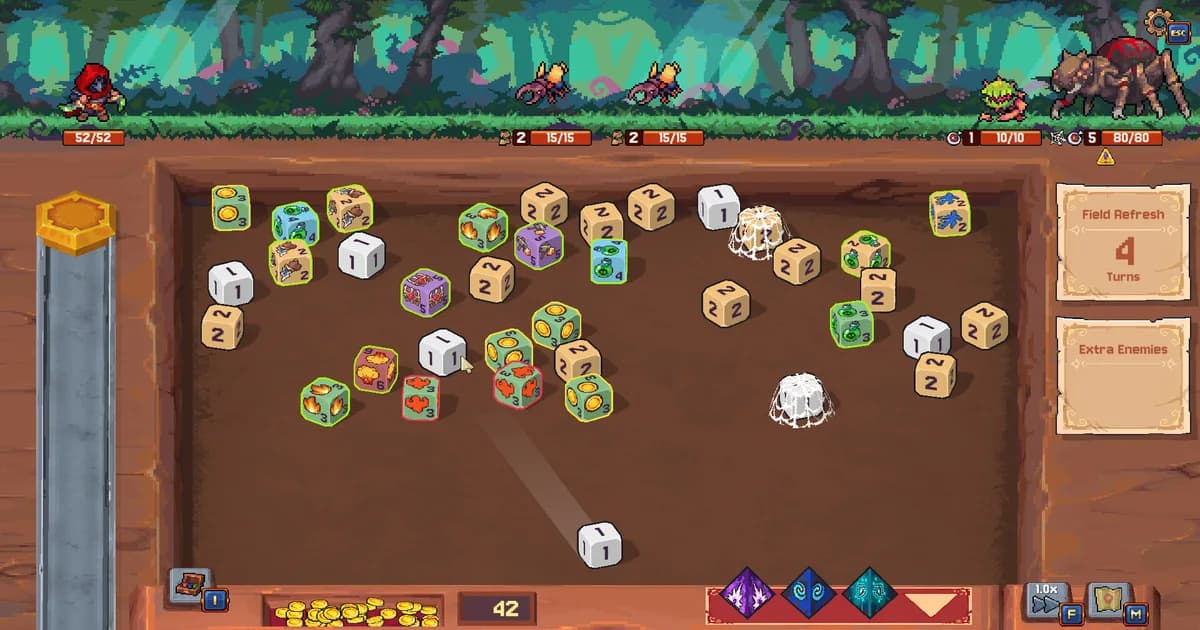
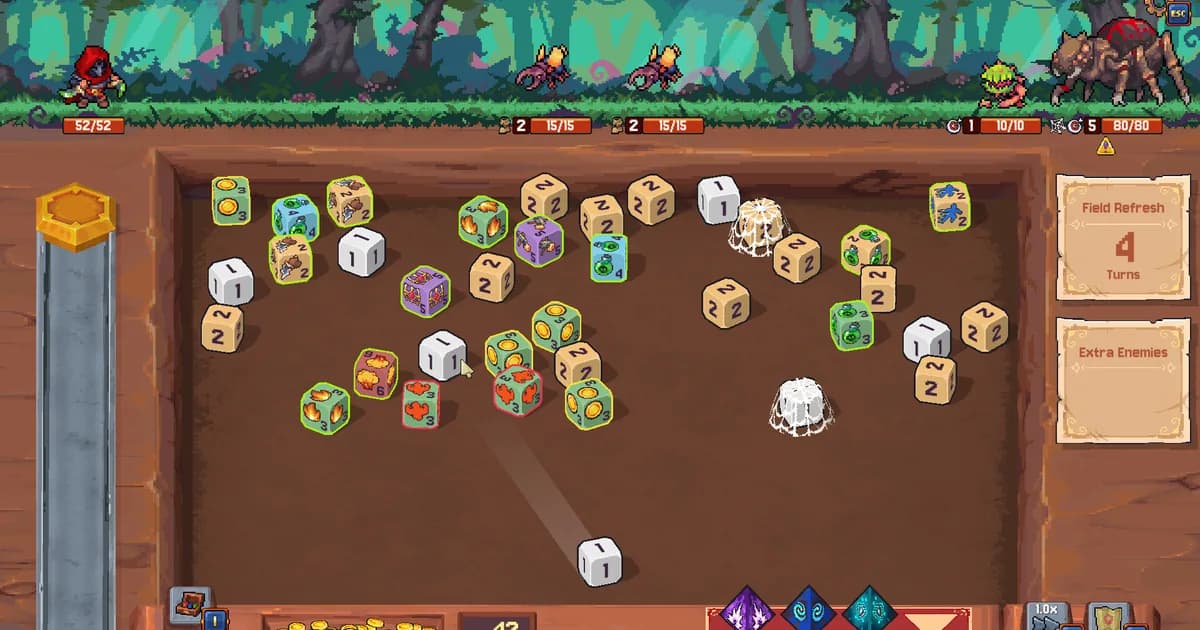
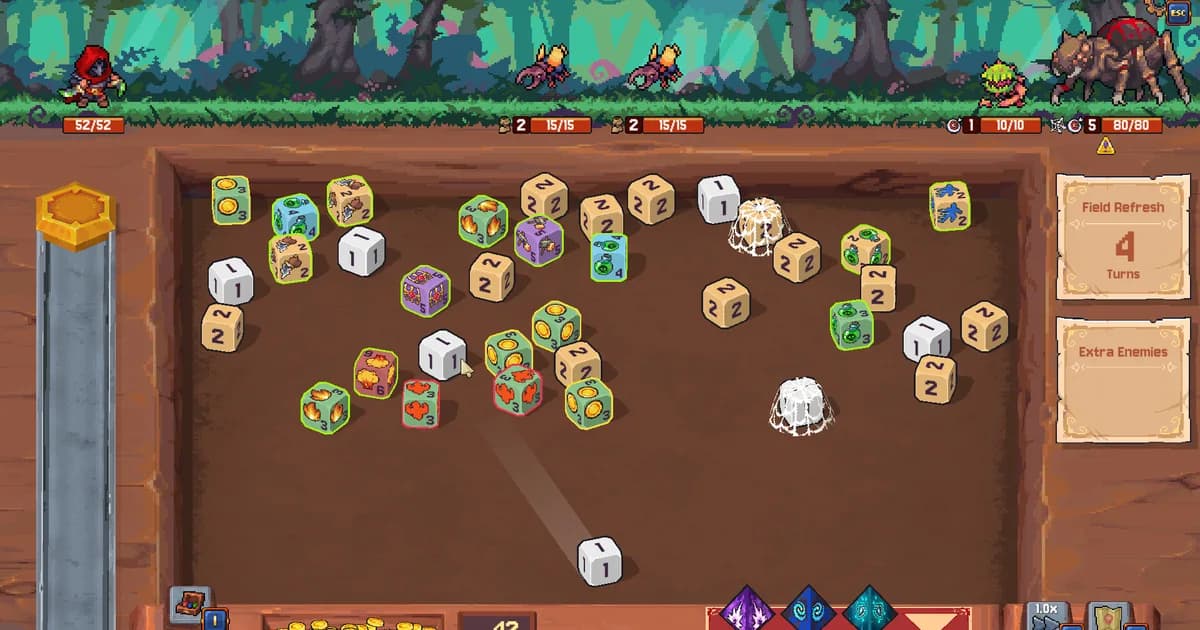
A physics dice throw mid-fight: dice land and interact based on the throw itself, not a fixed grid, which is the mechanic that separates Rune Dice from other dice roguelikes.
- Rune Dice Class Unlock Guide: How to Get All 8 Classes: a versioned route for all 8 classes; verify each requirement against the current class panel.
- Rune Dice Guide: All 8 Classes, Relics & Dice Synergies: Rune Dice guide covering all 8 classes, physics dice mechanics, relic priority
- Rune Dice Druid Unlock Guide: 4 Dice and Boss Strategy: Rune Dice Druid unlocks after defeating the Blighted Druid.
- Rune Dice Classic Mode: All 3 Locations in One Run: Rune Dice Classic Mode announced May 21 by developer Oleksii.
The physics dice system
The core mechanic that makes Rune Dice different from other dice-based roguelikes: physics. Dice thrown onto the board don't land in a static grid. They bounce off walls, collide with other dice in play, and land based on your throw angle and force.
This creates three things standard dice games don't have:
Throwing skill. You can aim to influence where a die lands and how it collides. The official store's physics description supports practicing force, angle, and board position; it does not establish a class-specific distance multiplier for the Archer, so treat any such build advice as version-sensitive.
Chain reactions. A die bouncing into another die already on the board can change both outcomes. If you've stacked Bomb dice relics, that second die's explosion triggers off the first die's landing, creating multi-dice chains on a single throw.
Momentum on mistakes. A throw that goes slightly wrong can land in a better position than intended if the bounce geometry works out. The variance isn't pure randomness: it's physics variance, which you can read and adapt to faster than card-probability variance.
The key early skill is learning where your current starting dice tend to land at different throw speeds. Compare the result in a safe encounter, then adapt the angle instead of assuming that a class has the same weight or bounce behavior described by an old guide.
GODEEPER: Full breakdown of class starting dice, best throw angles per class, and relic stacking that works with the physics system. Rune Dice Guide: All 8 Classes, Relics and Dice Synergies →
- Rune Dice New Game Plus Guide: NG+ Tips and Builds 2026: Rune Dice New Game Plus guide: how NG+ unlocks, what changes, which classes scale best,...
- Rune Dice Relics Guide: Best Builds and Relic Priority 2026: a versioned relic guide; verify item names, effects, and class priorities against current tooltips.
- Rune Dice Boss Guide: Beat Every Floor Boss & Webbed Dice: Rune Dice boss guide: how to beat floor bosses, counter webbed dice with Shuffle and...
- Rune Dice Physics Dice System: Throws, Merges & Chains: Rune Dice physics dice system explained: how throw angle and force decide merges, how chain...
- Rune Dice Necromancer Build: Soul Die and Death Mark: a class-specific build article; verify relic names and effects against current tooltips.
- Rune Dice Archer Build: Heartseeker and the 40-Combo: an Archer build article; verify the unlock trigger and relic details against the current game.
- Rune Dice Archer Build: Lateral Throws & the 40-Combo Unlock: throw-position advice and a versioned unlock discussion, subject to current UI verification.
- Rune Dice Mage Build: Burn, Freeze, and Merge Chains: Rune Dice Mage build guide covering the real merge-chain mechanic and the burn vs freeze decision.
- Rune Dice Bomb Build Guide: All 3 New Relics (Patch 1.2.2): Rune Dice bomb build is now real.
Relics: the run-defining system
Relics are the core progression layer that makes each Rune Dice run play differently from the last.
Bomb dice are a documented current theme, not a universal command to take every bomb item. The official August 12 patch notes add Blasting Powder, Booster Charge, and Chain Detonator and describe them as part of a bomb build. Take them when the current dice and relic offers support that plan, and compare their live tooltips before calling them best in every class.
A note on relic claims: some build guides describe an "Amplify" relic and a stacking combo with Gravity. This isn't confirmed in official patch notes or in-game relic text, and Gravity itself is a Rune (a situational board-fixing tool), not a stacking shop Relic. Treat any specific claim like this as unverified until you can check it against the current in-game tooltip.
Start relics (relics that appear in the first encounter) are worth less than they appear. They're not guaranteed in every run: they appear as rewards from hard fights or specific rooms, not on a fixed schedule. Don't plan a build around a start relic appearing.
Relic priority general rule: take relics that modify the dice and trigger patterns you are actually using. Build coherence matters across a full run, but the exact priority is patch-sensitive. The official store confirms relics and runes as progression pieces, while the current tooltip tells you the trigger and value.
- Rune Dice Bomb Build Guide: All 3 New Relics (Patch 1.2.2): three new relics from the August 2026 patch turn Bomb Dice into a real build.
Current official updates
The official Steam community feed records a useful set of changes for a September 2026 audit. Patch 1.2.4 adds Time Mirror, unlocked by collecting 20 dice, and Chameleon Mask, unlocked by dealing 1,000 damage; it also adds a boss splash effect and reworks Veilstone. Patch 1.2.2 adds Blasting Powder, Booster Charge, Chain Detonator, Spring Coil II and III, and Relief Rune, alongside board physics fixes. Patch 1.2.0 adds Ward, Dispel, eight relics, the Sporecaller, Hollow Warden, and Illusionist minibosses, Wailing Shade, and merge-physics fixes.
These are better freshness anchors than a stale tier list. If a build guide refers to a pre-1.2 board interaction, check it against the current notes and tooltip. The updates also show why exact recommendations should name their patch: a relic or miniboss introduced in 1.2.0 may not have existed when an older class ranking was written.
How to unlock all classes
The official achievement page is the safest public progress reference used in this audit. “Class Explorer” tracks unlocking five classes, and “Full Tavern” tracks unlocking all classes. The official community page lists the eight names. Together those sources confirm the roster and the existence of class progression without pretending that an old third-party number is still the current trigger.
For an individual unlock, check the current class screen and achievement text after each run. If an external guide says a class requires a particular combo, boss, or difficulty, verify that condition in the installed build before presenting it as definitive. This is especially important for Archer, Druid, and any class whose unlock guide was written before the 1.2 updates. Keep a screenshot or patch reference with the condition when you document it for readers.
The site class unlock guide can still be used as a route planner, but its conditions should be treated as versioned evidence rather than timeless facts. If it conflicts with the current UI, the current UI wins.
- Rune Dice Druid Unlock Guide: Blight Druid Boss Strategy: a versioned route for the Druid unlock; verify the current in-game requirement before relying on a specific boss or difficulty condition.
New Game Plus and mode-specific claims
The site has a separate Rune Dice New Game Plus guide, but the official Steam pages checked in this audit do not publish a complete current table for NG+ unlocks, scaling, carry-over, or boss behavior. This hub therefore does not repeat the old exact claims as facts. Open the mode in the installed build, read the modifier text before an encounter, and record what actually changes.
That caution does not make the mode impossible to plan. A useful first NG+ checklist is to confirm whether the class starts with its normal dice, whether the shop and relic pools differ, whether the map adds modifiers, and whether a boss's attack pattern is visibly different. Change one class or relic plan at a time. If an update changes the mode, the official community feed and the current UI should be updated before this hub makes a stronger claim.
The same rule applies to recommendations. Warrior, Paladin, Rogue, Mage, Archer, Druid, Bard, and Necromancer are official class names, not proof that one is best for an undocumented NG+ modifier. Choose the class whose current dice and special ability you can read, then build around the rewards that appear in that run.
How long to beat Rune Dice
A run length depends on the route, class, and how long you spend reading the physics board. The official store emphasizes procedural encounters and chain reactions but does not publish a universal 20-45 minute completion time, so use the clock in your own clears rather than treating that range as a guarantee.
For a first clear, budget enough attempts to learn throw force, bounce geometry, matching merges, shops, relics, and bosses. The official store confirms that multiple heroes and eight unique classes support replay, but it does not define a fixed number of attempts to the credits. A beginner who takes notes after each physics mistake will progress more reliably than one who chases a supposed speed threshold.
After the first clear, use the current mode screen and achievement page to define your own completion target. The achievement page exposes “Class Explorer” and “Full Tavern,” while the official patch feed adds new relics, items, and minibosses over time. A speedrun number or a claim that one class has the fastest route needs its own current leaderboard source and should not be treated as a general guide fact.
Tips that apply to every class
Read the tooltip before taking a bomb item. Patch 1.2.2 adds a documented bomb package, but that does not make every bomb pickup correct for every class. Take it when the current dice and relic plan can trigger it.
Watch the bounce geometry. Your first two runs, throw at different speeds and angles to learn where your starting dice land. That knowledge pays off on every subsequent run.
Don't fill your dice pool with filler. Adding dice that conflict with your relic setup is worse than having fewer dice. A tight 5-die pool where every die triggers at least one relic is stronger than a 10-die pool with dead draws.
Read the boss information before throwing. Bosses have distinct abilities according to the official store. Use the current preview or tooltip when it is available, and do not assume every boss exposes the same weak spot or opening sequence.
On the last boss: check the current encounter rules instead of importing a community complaint from an older build. If the boss changes how dice behave, write down the rule before adapting the opening throw; if it does not, use the same merge and chain discipline as the preceding rooms.
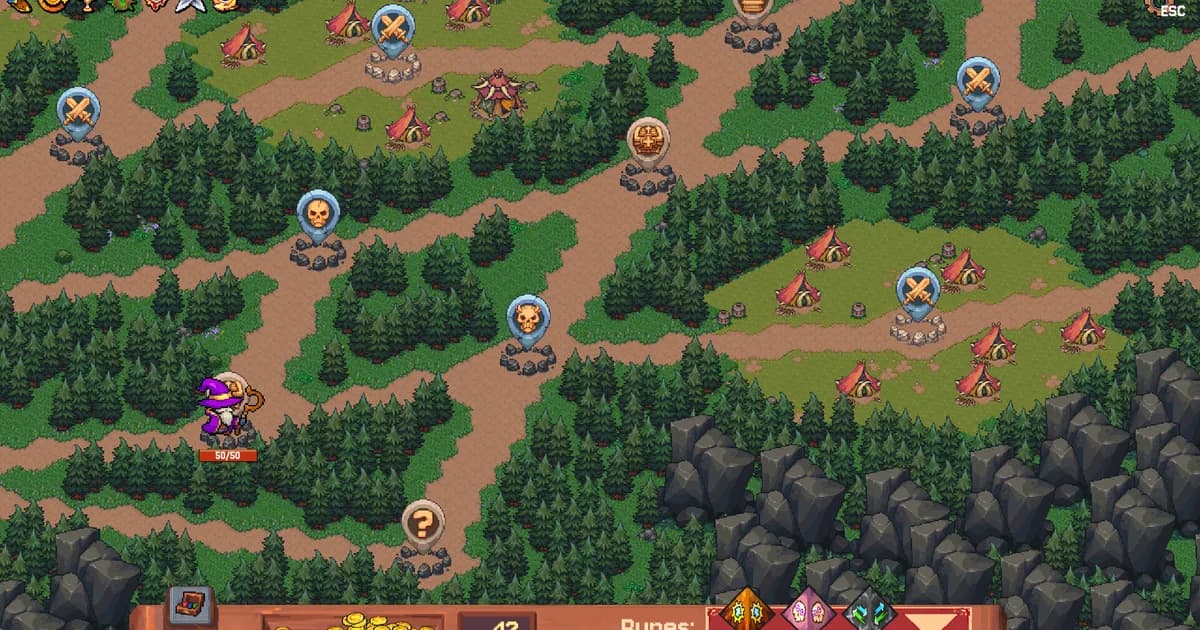
The overworld map between encounters: node icons mark combat, treasure, and mystery events along branching forest paths.
All Rune Dice guides
- All Rune Dice coverage: every Rune Dice guide, review, and news post published on GameBrief, in one index.
- Rune Dice Guide: All 8 Classes, Relics and Dice Synergies: full class breakdown, best relic priorities, throw mechanics, and how the physics system works for beginners.
- Rune Dice Tier List: All 8 Classes Ranked 2026: S-to-C ranking for every class with best-pick guidance by playstyle and experience level.
- Rune Dice Druid Unlock Guide: Blight Druid Boss Strategy: a versioned Druid unlock route; verify the boss, difficulty, and class details against the current game.
- Rune Dice Classic Mode: All 3 Locations in One Run: Classic Mode announced May 21, playtested May 28 to June 4, and has since fully released (v1.1.0, approximately June 22, 2026).
Related Reading
- Rune Dice beginner guide: the basic physics, class, and relic walkthrough.
- Rune Dice physics dice guide: throw force, merges, and board interactions.
- Rune Dice boss guide: current boss and webbed-dice coverage.
- Rune Dice patch 1.2.2 bomb build guide: the documented bomb package from the August update.
References
- Rune Dice on Steam: store page, system requirements, patch notes
- Rune Dice official Steam community feed: official patch notes, class list, and current update history.
- Rune Dice achievements: 34 achievements, including Class Explorer and Full Tavern.
- r/RuneDice on Reddit: community tips, build discussions, and class unlock questions
- Smart Raven Studio on Steam: developer page and update history
Frequently asked questions
What is Rune Dice? A physics-based tactical roguelike where you throw real dice that bounce and interact. The official store lists 8 unique classes, multiple heroes, relics, runes, altars, bosses, and a procedural map. It is available on PC, PS5, Xbox Series, and Switch.
How many classes are in Rune Dice? 8: Rogue, Warrior, Mage, Archer, Druid, Bard, Paladin, and Necromancer. The official pages confirm the roster; use the current class panel for unlock conditions.
What is the best class in Rune Dice? There is no official tier list. Pick from the current dice and special ability you understand, then use the editorial class ranking guide for a versioned opinion.
What are relics and how do I use them? Passive items found in shops and rewards. They change how dice, merges, and trigger conditions behave. Build around the current dice and tooltip, and note that patch 1.2.2 adds a specific bomb-build package rather than proving that bombs are always best.
How do you unlock classes? The official achievement page confirms progress for discovering five classes and then all classes, but the checked public sources do not publish every current individual trigger. See the Rune Dice class unlock guide as a versioned route and verify its conditions in the current UI.
What is NG+ in Rune Dice? The site has a New Game Plus guide, but the official sources checked here do not publish a complete current modifier or carry-over table. Read the mode's current UI and encounter text before relying on an exact NG+ claim.
Is Rune Dice worth it? Yes for fans of physics-driven roguelikes. Steam currently shows 79% Mostly Positive from 1,266 reviews and 93% positive across 74 recent reviews, with a $14.99 price and 34 achievements.
About the author

Senior Critic & Analyst
Former game data analyst turned critic with 11 years covering indie and mid-tier games. Based in Austin. Runs spreadsheets on games most people just play.
- 11 years games criticism
- Former game economy analyst
- Roguelike and strategy specialist
Keep reading
Rune Dice Druid Unlock Guide: 4 Dice and Boss Strategy
Guides · 8 min
Rune Dice Tier List: All 8 Classes Ranked for 2026
General · 9 min
Rune Dice Classic Mode: All 3 Locations in One Run
News · 5 min
Rune Dice Guide: All 8 Classes, Relics & Dice Synergies
General · 9 min
Rune Dice Boss Guide: Beat Bosses and Counter Webbed Dice
Guides · 9 min
Rune Dice Class Unlock Guide: How to Get All 8 Classes
General · 8 min
Game deals · affiliate links

Disclaimer
This article is published for informational and entertainment purposes. It does not constitute professional financial, legal, or technical advice. Game performance, online services, patch schedules, and store listings change. Verify critical details (pricing, system requirements, regional availability) with publishers and storefronts before you buy. Affiliate links, where present, help support our editorial work and are labelled in our affiliate disclosure.
Comments
Loading comments…