
GuideRune Dice
Rune Dice Guide: All 8 Classes, Relics & Dice Synergies
This Rune Dice guide covers all 8 classes, the physics dice mechanic, relic priority, and best synergy builds for new players on any platform.
TL;DR: Rune Dice has 8 classes. For a straightforward starting plan, try Warrior's Shield and Stun dice; that recommendation is editorial. Every class has its own signature dice, and the official store describes the core loop as launching dice, creating chain reactions, and building synergies between dice, relics, and runes.
Rune Dice guide: best starting class (quick answer)
- Rune Dice launched May 19, 2026 on PC, PS5, Xbox Series X/S, and Switch: developed by Smart Raven Studio, published by Kwalee
- 8 classes, each with three heroes listed in the current class reference and its own signature dice pool
- Launching dice creates the game's magical chain reactions; merging is also used for progression and unlocks
- Relics provide class-affiliated or universal build effects; runes are battlefield consumables
- Warrior is our beginner recommendation because Shield and Stun are easy to read; this ranking is editorial
- Steam review score: Mostly Positive from 800+ reviews
What is Rune Dice?
Rune Dice combines tactical deckbuilding with dice throws: the official store describes launching dice to create magical chain reactions. Each class has its own pool of dice and class-affiliated relics, while runes can manipulate the battlefield. That makes the useful beginner question less "which fictional resource does this class use?" and more "which dice and effects do I want to assemble?"
The game launched on May 19, 2026 from Smart Raven Studio and publisher Kwalee. Its official description emphasizes distinct hero classes, unique abilities, and synergies between dice, relics, and runes.
This Rune Dice guide covers the 8 classes, how to read the dice system, and which relic categories to prioritize for a successful first run.
How the physics dice system works
Most dice games only ask you to read a result. Rune Dice adds a physical launch-and-chain layer: its store page describes launching dice to create magical chain reactions, while the class-unlock reference records merge-based goals such as getting a die to value eight or higher.
Merge mechanics: Merging is a named game action used by class dice, relics, runes, and unlock conditions. The current reference material does not support the old claims about a universal "merge trigger window" or a separate position-based relic system, so treat those as unsupported rather than as rules.
Class effects: Read the named effect on the die instead of assuming every class has a hidden resource. The effects reference documents concrete behaviours such as Shield blocking physical damage, Root preventing movement, and Lightning jumping between enemies.
GODEEPER: Physics mechanics that affect positioning come up in other tactical games too. Gambonanza Best Builds Guide →
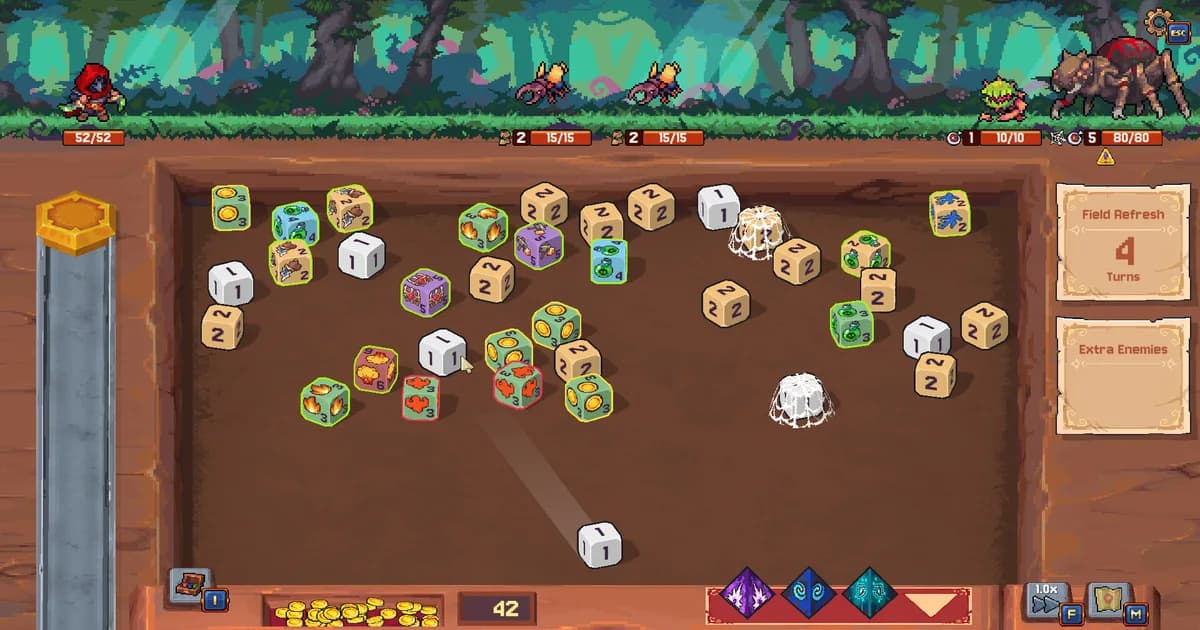
A crowded combat board. Reading which dice can merge into a chain, not just throwing at the nearest one, is the core skill the physics system tests.
Rune Dice guide: all 8 classes and starting dice
Warrior: The class reference lists Fury, Overwhelming, Shield, and Stun dice. Shield blocks one physical damage per shield stack; Stun prevents an enemy from attacking or moving while it lasts. This is our simplest defensive recommendation for a first run.
Mage: Fire, Freeze, Lightning, and Arcane dice. Fire deals damage over time, Freeze restricts movement while still allowing attacks, Lightning jumps to another enemy with decreasing damage, and Arcane can either deal bonus damage or heal.
Rogue: Backstab, Blind, Dodge, and Poison dice. Backstab is bonus damage from behind, Blind reduces accuracy, Dodge ignores the next direct enemy attack, and Poison deals damage per stack over time. The source-backed Rogue identity is these effects, not the earlier claim about special edge tiles or flanking zones.
Bard: Inspire, Encore, Strength, and Weakness dice. Inspire duplicates one merge effect and decreases by one, Encore returns to the field after activating, Strength boosts direct attacks, and Weakness reduces physical attack. The class guide lists merging a die to value eight or higher as its reported unlock condition.
Necromancer: Curse, Death Mark, Drain, and Soul dice. Curse adds damage when a cursed enemy is hit, Death Mark damages the rest of the board when the marked enemy dies, Drain heals for a percentage of damage dealt, and Soul increases the hero's maximum HP. The source does not describe a Soul-token bonus-throw economy, so this guide does not claim one.
Archer: Sniper, Pierce, Finisher, and Knockback dice. Sniper is a long-range single-target attack, Pierce hits the enemy behind the target for bonus damage, Finisher rewards the killing blow, and Knockback pushes the target when possible. The reported class unlock is a 40-value dice combo in one throw; Archer is not a Ranger variant.
Paladin: Holy, Rage, Regeneration, and Sacrifice dice. Holy damage heals, Rage has a stacking attack bonus, Regeneration heals at the end of the turn, and Sacrifice costs 1 HP. This is a source-backed sustain/control profile; the older "stored retribution" description was not supported.
Druid: Growth, Root, Spirit, and Thorn dice. Growth heals and raises maximum HP, Root prevents movement and deals damage over time, Spirit attacks three random enemies, and Thorn retaliates against physical attackers. The reported class unlock is defeating Blight Druid in Hard Mode.
Step-by-Step: choose a first class
- Confirm the roster: Archer, Bard, Druid, Mage, Necromancer, Paladin, Rogue, and Warrior.
- Choose Warrior if you want the clearest defensive plan, or pick a class whose four named dice match the effects you want to learn.
- Read the exact dice effects before prioritizing a relic or rune; do not infer a hidden resource from the class theme.
- Use the documented rune effect that solves the current board problem, then reassess your dice and relic triggers after the field changes.
Best class matchups by playstyle
| Playstyle | Recommended class | Reason |
|---|---|---|
| Beginner, wants a direct plan | Warrior | Shield and Stun effects |
| Elemental effects | Mage | Fire, Freeze, Lightning, Arcane |
| Survival/control | Druid | Growth, Root, Spirit, Thorn |
| Curses and sustain | Necromancer | Curse, Death Mark, Drain, Soul |
| Long-range damage | Archer | Sniper, Pierce, Finisher, Knockback |
| Buff/debuff play | Bard | Inspire, Encore, Strength, Weakness |
Rune Dice guide: relic priority and what to take first
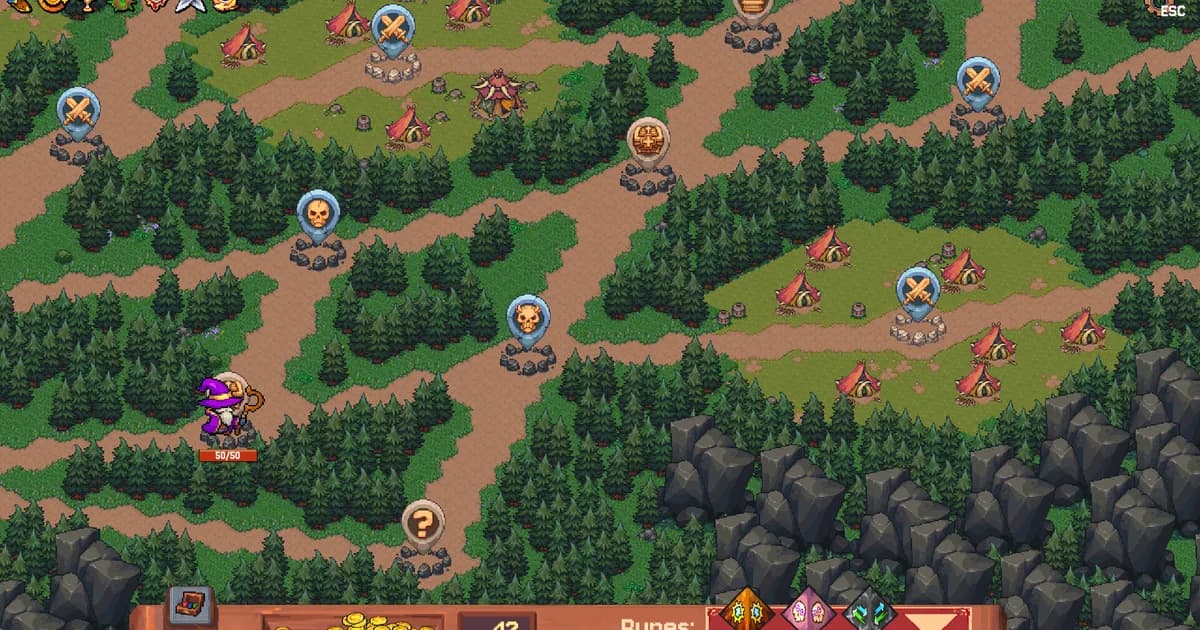
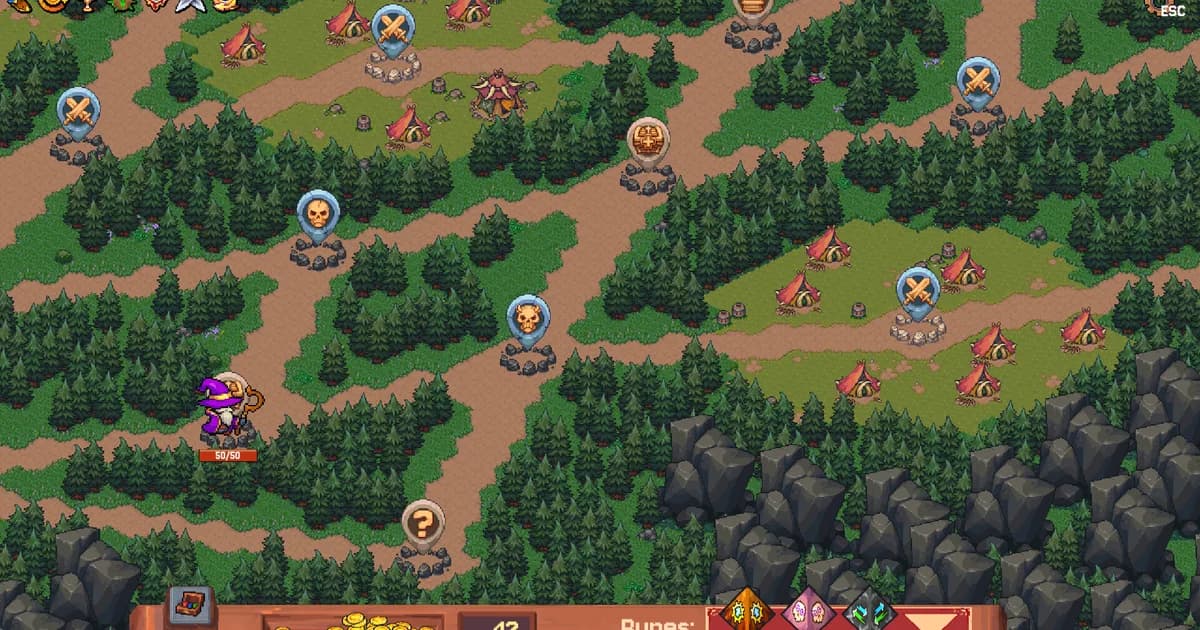
The overworld map: skull icons mark enemy encounters, tents mark camps, and the question mark is an unknown event. Runes are shown in the inventory bar at the bottom.
Not all relics are equal on floor 1. The first three relic picks define what your run becomes:
Start with the class label. The class reference says each class has its own dice pool and class-affiliated relics, alongside universal relics. Check that a relic names a die or effect you actually use before treating it as a priority pick.
Read the exact trigger. The relic reference includes concrete, narrow effects such as a Finisher kill granting a coin or a Sniper die dealing double damage in a particular situation. Do not generalize one relic's trigger into a universal class rule; verify the current tooltip before building around it.
Defensive relics are lower priority than they feel. New players instinctively take armor/block relics early because survival feels urgent. In practice, increasing damage output kills enemies faster, which reduces the number of attacks you take. Offensive relic picks typically produce safer runs, not less safe ones.
Rune usage: when consumables matter
Runes are consumables placed on the battlefield to manipulate combat. The current rune reference lists, among others, Amplify (+1 to all dice values on the field), Bomb (adds a value-5 Bomb die), Gravity (pulls nearby dice together), Life (heals 12 HP), Protection (gives 10 shields), and Shuffle (repositions field dice without changing their values or types).
Use a rune when its documented effect solves the current board problem. Gravity can set up nearby dice without starting a turn, while Shuffle changes positions without changing values or types; those are concrete tactical uses, not a universal boss-only rule.
For example, Amplify raises all dice values on the field, Protection gives shields, and Weakness applies three Weakness stacks to all enemies. Their value depends on the current field; the source does not support a blanket rule that every rune should be saved for a boss.
GODEEPER: Roguelite resource management (when to save and when to spend) applies across the genre. All Hail the Orb Tier List and Unlocks →
Frequently Asked Questions
How many classes are in Rune Dice? 8 classes, each with multiple hero variants. Total distinct starting configurations is larger than 8.
Best class for beginners? Warrior is our editorial recommendation because its class pool includes Shield and Stun dice. It is a straightforward defensive/control plan while you learn the game.
How does the physics dice mechanic work? The official store describes launching dice to create magical chain reactions. Merging is a named action used by dice and runes, and the class-unlock reference includes a goal to get a die to value eight or higher by merging. Avoid treating unsupported tile or throw-angle bonuses as universal rules.
Difference between relics and runes? Relics are class-affiliated or universal build effects. Runes are consumables placed on the battlefield to manipulate combat, such as Gravity, Amplify, Protection, or Shuffle.
Is Rune Dice on console? Yes: PC, PS5, Xbox Series X/S, and Nintendo Switch, all launched May 19, 2026.
Does it have procedural maps? Yes. The map reference describes procedural rows leading to a boss, with basic and elite combat, mini-bosses, events, shops, upgrades, chests, and altars.
Related Reading
- Rune Dice Tier List: All 8 Classes Ranked for 2026: S-to-C ranking for every class once you understand the basics, with community-sourced Amplify and Gravity combo notes.
- Die in the Dungeon Complete Guide: another dice-based roguelite; its synergy logic (dice as resources, not randomness) transfers directly to Rune Dice builds.
- Gambonanza Tips Guide: probability-based roguelite with relic economy that mirrors Rune Dice's priority system.
- Best Indie Games Under $20 in 2026: curated picks for the roguelite and strategy space at the same price range.
- Die in the Dungeon Tips: Dice, Board, and Build Basics: covers a similar dice-positioning loop where board placement matters as much as what you roll.
- Best Roguelike Games 2026: 7 Picks for Every Budget: a curated list of standout roguelites this year, useful for finding your next run after Rune Dice.
- All Hail the Orb Alchemy Guide: 9 Discoveries Ranked: ranked breakdown of a different roguelite upgrade system, for players interested in resource-loop theory.
- Gambonanza Review: Chess Balatro or Something Better?: a review of another physics-meets-strategy roguelite that shares Rune Dice's spatial decision-making.
- Slay the Spire 2 Co-op Guide: All 5 Characters Ranked: class tier list and synergy breakdowns for the genre benchmark, good contrast for Rune Dice class evaluation.
References
- Rune Dice on Steam
- Rune Dice Heroes: current class roster, heroes, themes, and signature dice
- Rune Dice Dice: class dice and their documented effects
- Rune Dice Effects: effect-by-effect behaviour reference
- Rune Dice Runes: battlefield consumables and their effects
- Rune Dice Map: procedural map node types and locations
- Rune Dice on Gematsu
- Smart Raven Studio
Was this guide helpful?
About the author

Games Critic
Games writer and reluctant optimist who has reviewed over 400 titles across 9 years. Irish, currently in Berlin. Has strong opinions about tutorial design.
- 400+ games reviewed across 9 years
- Platformer and horror specialist
- Narrative design focus
Keep reading
Rune Dice Tier List: All 8 Classes Ranked for 2026
General · 9 min
Rune Dice Complete Guide 2026: Classes, Relics, and Builds
Guides · 12 min
Rune Dice Druid Unlock Guide: 4 Dice and Boss Strategy
Guides · 8 min
Rune Dice Classic Mode: All 3 Locations in One Run
News · 5 min
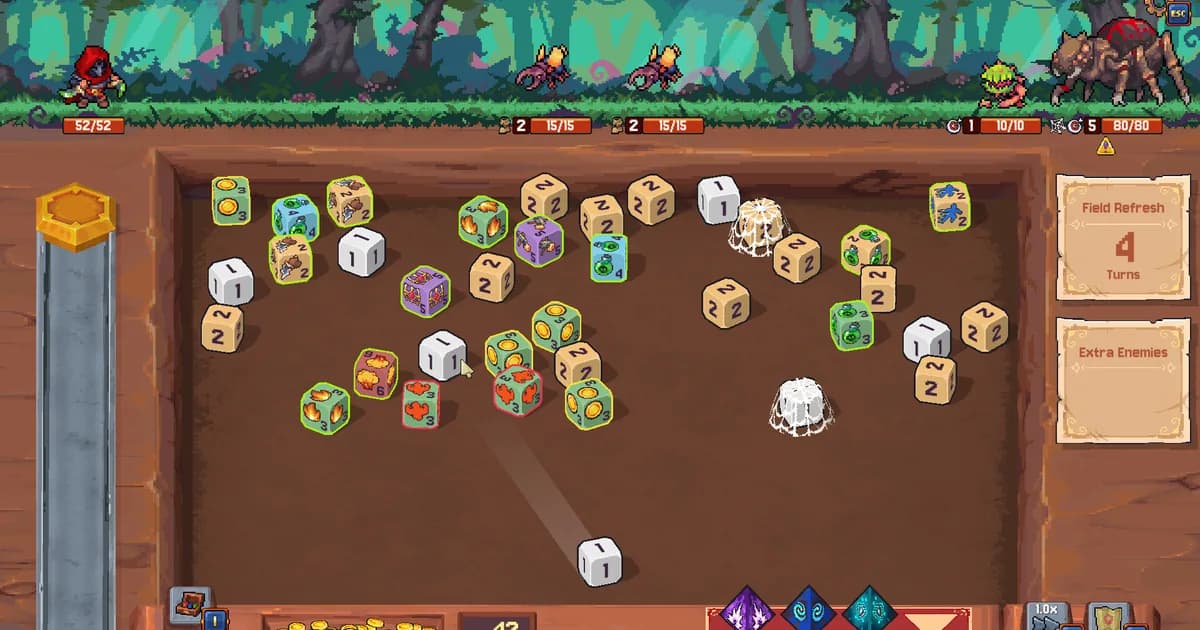
Rune Dice Boss Guide: Beat Bosses and Counter Webbed Dice
Guides · 9 min
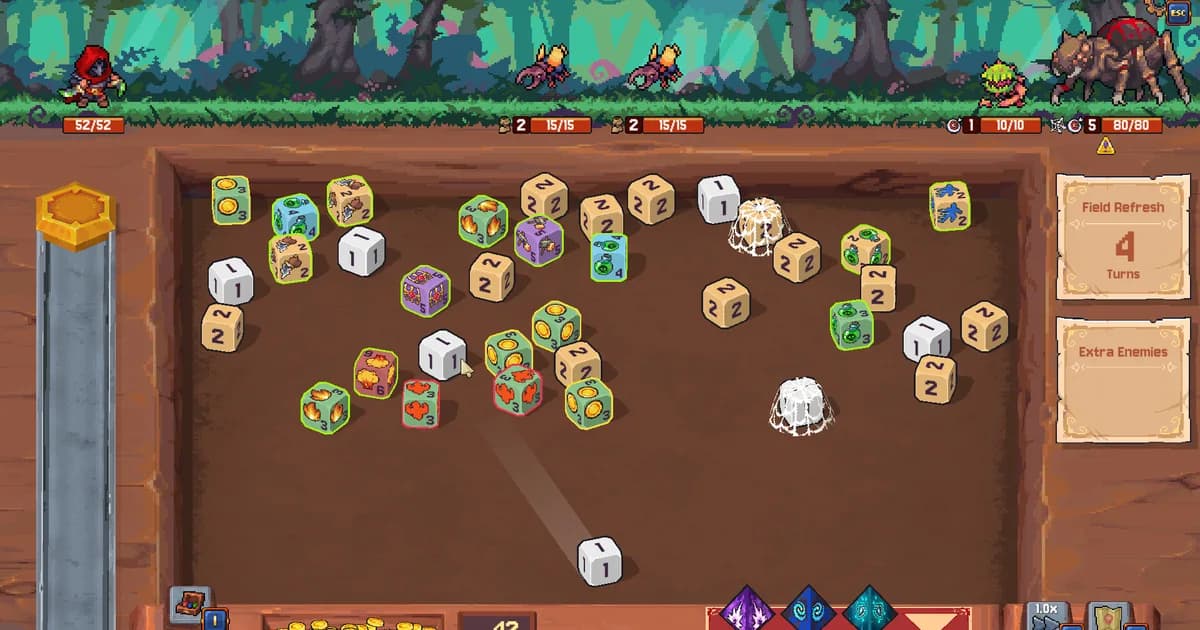
Rune Dice Class Unlock Guide: How to Get All 8 Classes
General · 8 min
Game deals · affiliate links

Disclaimer
This article is published for informational and entertainment purposes. It does not constitute professional financial, legal, or technical advice. Game performance, online services, patch schedules, and store listings change. Verify critical details (pricing, system requirements, regional availability) with publishers and storefronts before you buy. Affiliate links, where present, help support our editorial work and are labelled in our affiliate disclosure.
Comments
Loading comments…