
GuideLegionbound
LegionBound Ascension Chain: Timing, Risk, Recovery 2026
About the game
LegionBound
Spicy Garlic Games
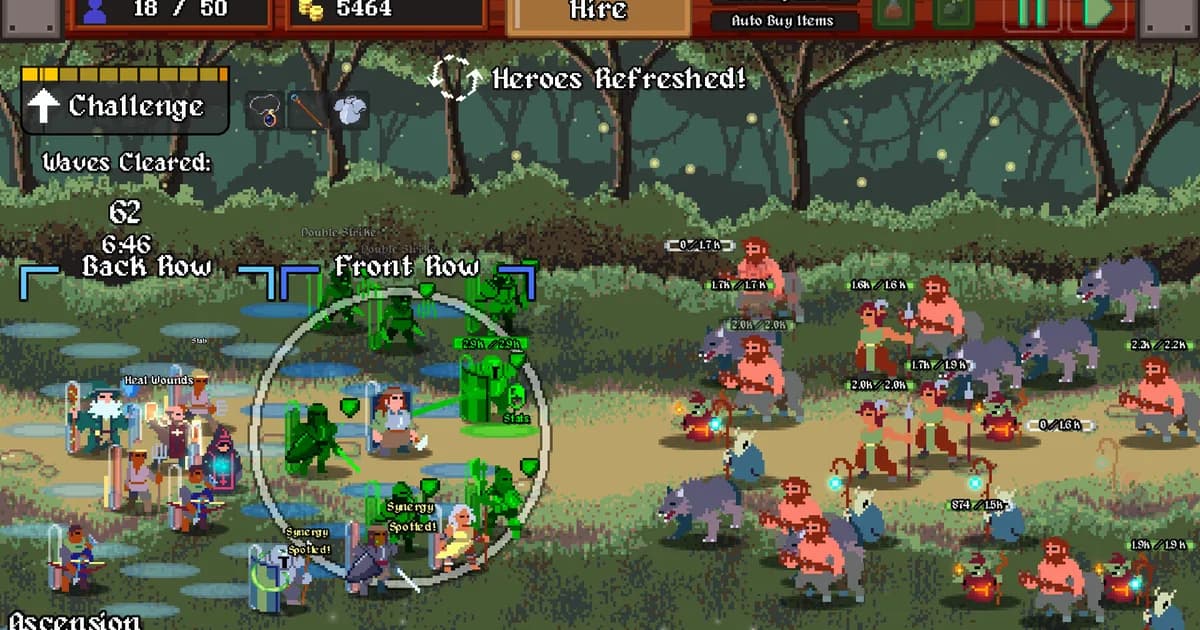
The LegionBound ascension chain basics are covered fast. You commit to a class cluster, find a compatible synergy pair by wave 4, and preview the result before confirming. That part clicks in the first few hours. What doesn't click until you're 15 or 20 hours in is what to do after: when to push for a second merge, which class goes next, how to protect the investment when enemy health starts climbing, and what you're actually supposed to do when your Ascended hero hits the floor at wave 23.
The LegionBound ascension chain (sequencing merges across a full run, not just triggering the first one) is what separates players who top out around wave 20 from players who take Adventure Mode into its third loop.
TL;DR: Aim for your second Ascension in the mid-run once enemy scaling starts to outpace your tier-1 merged hero. Front-liners first, damage dealers second. Protect Ascended heroes with row position and item priority. When an Ascended unit dies at high waves, assess whether rebuilding the chain is actually faster than finishing with what you have. Skill tree recruitment speed nodes accelerate the whole chain.
LegionBound ascension chain guide: quick answer
Ascend your front-line tank class first, then your damage dealer, then a secondary loop anchor if the run is long enough to reach a third merge. Every decision in the chain is about protecting the merge that already happened while building toward the next one.
Current status: September 2026
The current Steam page lists 42 classes, over 800 possible Ascension heroes, and parties of up to 50 heroes. The checked snapshot is Very Positive at 82% across 687 reviews, with an active $7.99 sale price against a $9.99 list price. The official announcements show Patch 1.12 on September 10 fixing a targeting crash, lingering-zone hangs, and stuck item disables; the article's timing advice remains build guidance rather than a promise of a fixed wave.
Key takeaways
- Second Ascension target: your front-line tank, triggered once tier-1 merged hero starts losing ground to enemy scaling
- Third Ascension target: your primary damage dealer, once the tank chain is stable
- Row positioning matters more once aura-active Ascended heroes are in play; keep aura units adjacent to the heroes that benefit from them
- When an Ascended hero dies in the mid-run, assess rebuild time vs. run length before committing resources
- Recruitment speed skill tree nodes compound across the whole run: they're the single highest-value investment for long ascension chains
- Battle Mode lets you build at your pace; in Adventure Mode, treat the first two Ascensions as a practical baseline before the Endbringer, with a third as a bonus
Step-by-Step: plan a LegionBound ascension chain
1. Commit to one class cluster: use the first recruits to find a compatible synergy pair rather than spreading the early pool across unrelated classes. 2. Merge the first front-line pair: trigger the first Ascension around the first safe merge window, then stabilize its row and item coverage. 3. Prepare the second tank merge: keep a second compatible pair ready and preview the result when the first Ascended front-liner starts losing ground to enemy scaling. 4. Rebuild only when the clock allows it: after an Ascended death, compare the waves left before the next boss with the time needed to find and merge a replacement pair.
When to trigger the second Ascension
The timing signal isn't a specific wave number: it's your front-line Ascended hero starting to absorb multiple hits per wave without recovering. That's the game telling you that enemy scaling is pushing against your tier-1 stat floor. When you see that pattern, the second merge pair needs to be ready.
In practice, most runs reach this point somewhere in the game's middle sections. The merge pair needs to be in your party one or two waves before you see the durability problem, not after. Waiting until the tank is already close to death means your window for a safe merge has passed.
Damage dealers feel fine longer. An Ascended caster with active synergy subclass is putting out real numbers even as enemy health climbs. The second damage Ascension matters, but it's not urgent in the same way the tank is. Sequence it one or two waves after the second tank merge, once the front line is stable again.
Getting the tank chain's second Ascension done before the front line is overwhelmed is the key decision in the mid-run.
Which hero to Ascend and in what order
The priority rule across all three Ascensions: front-line sustain before damage. This holds from the first merge through the third.
First Ascension: Your earliest eligible synergy pair. In a Warrior group build, prioritize a documented Warrior-group prerequisite pair and confirm the result in the preview.
Second Ascension: Your tank-chain front-liner. Knight, Guardian, or whichever class is sitting at the front of your row taking sustained damage. The stat multiplier from the second Ascension is what keeps that class viable as enemies scale.
Third Ascension: Your primary damage class. By the time a third merge is on the table, the tank chain is established and the bottleneck on run length is damage output. Ascended Sorcerer with Warlock synergy active is the standard damage target in a Warrior group build. In a Tax Collector build, Barbarian or Tax Collector itself, depending on which has the higher item investment by that point.
The wrong sequence: merging a damage dealer as your second Ascension because their raw stats look better than your tank candidate. You'll notice the problem two or three waves later when enemies route around your weakened front line and reach the casters.
GODEEPER: The full breakdown of which classes belong to each chain and what subclasses they activate is in the synergy guide. LegionBound Synergy Guide: All 42 Classes & Groups →
Protecting Ascended heroes past wave 30
By wave 30, your Ascended heroes are the run. Losing one isn't just a setback; it's usually the end of any realistic path to the Endbringer or a deep Battle Mode run. Protection becomes active work, not passive hope.
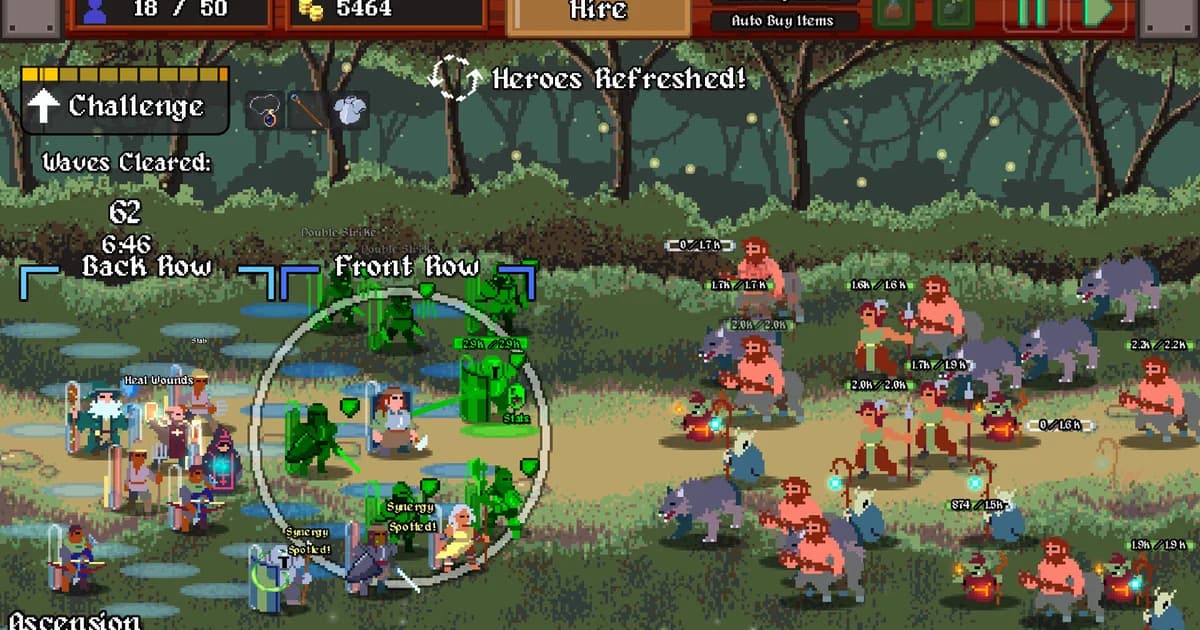
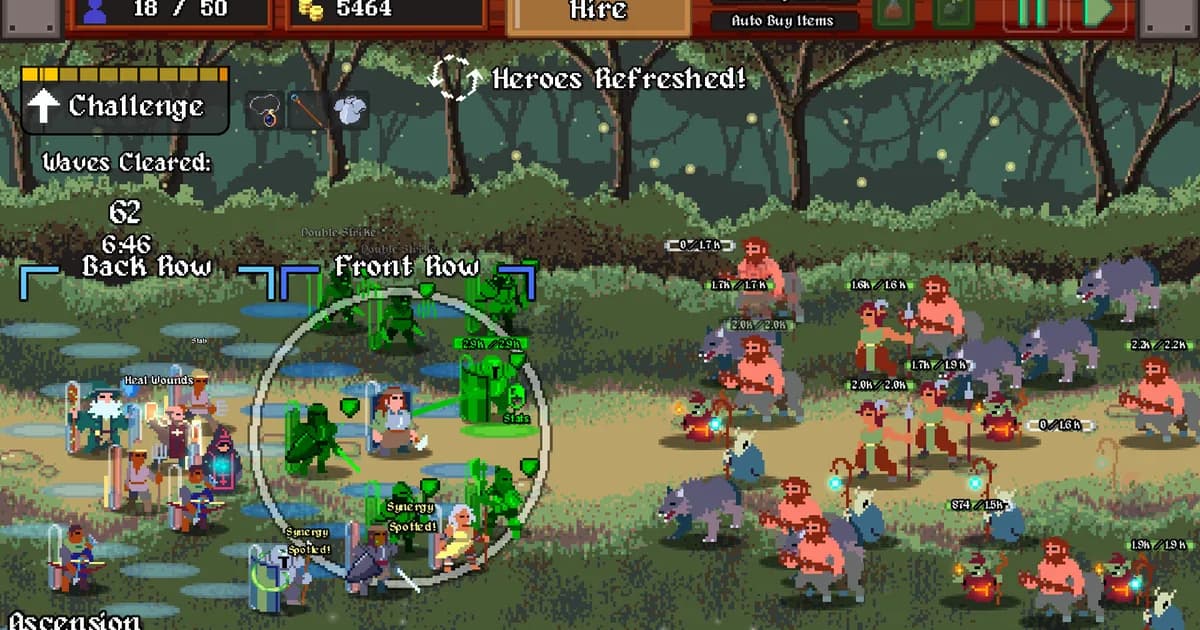
Your highest-value Ascended hero shouldn't be in the front row unless it's a tank built to absorb damage. Caster Ascensions belong a row back. That sounds obvious, but it shifts with each new Ascension: as heroes get added and rows fill, audit your positioning after each merge.
The aura question is related. Community play has observed that classes with aura abilities need nearby heroes in range to benefit from them. Once an Ascended hero has an aura active, keep the heroes that benefit most from it adjacent rather than spread across the battlefield. This is a separate calculation from the general row order.
Item priority follows the same asymmetry: survivability items on an Ascended front-liner are worth more than offense items on a class that's already dealing well. Losing a damage multiplier costs DPS. Losing the Ascended tank can end the run.
Watch for target saturation at wave 30+. Enemy focus tends to cluster on your highest-threat units, which by this point are your Ascended heroes. If one class is drawing disproportionate fire, repositioning mid-encounter can reset which unit they're targeting.
When not to Ascend
The impulse to merge whenever an eligible pair arrives is strong and usually correct. There are situations where it isn't.
If one of your candidates just took serious damage, wait. A merge that includes a hero at low HP produces the same Ascended unit as a clean merge, but you're absorbing the cost of that lost durability immediately. Both heroes should be at reasonable health before the pair combines.
Sometimes keeping two heroes separate is worth more than merging them. If the second copy of a class fills a specific row gap or carries an item doing active work, completing the merge collapses a configuration that's currently functional. The synergy value of two heroes active in different rows can outweigh the Ascension bonus for several waves.
Late in Adventure Mode, even a clean merge can be the wrong call. Triggering a third Ascension two waves before the Endbringer means the merged hero enters the final encounter without warmup time. A strong two-hero pair in that slot is sometimes better than a rushed merge that scrambles item distribution right before the fight.
Recovering after an Ascended hero dies
The permanent loss of two component heroes is the sharpest pain in LegionBound. The first instinct is to rebuild. The better question is whether rebuilding is possible before it matters.
If the loss happens in the run's first half, rebuild. There are enough waves ahead to find a new compatible pair and get the merge done before enemy scaling catches up. Steer your next recruitment choices toward the missing prerequisite.
In the mid-run, do the math first. Count the waves to your next checkpoint: the Endbringer in Adventure Mode, your current wave target in Battle Mode. If rebuilding takes eight waves and you have ten, it's viable. If the new merge completes one wave before a boss encounter, the disruption to items and positioning probably isn't worth it.
Late in the run, generally don't chase it. New pairs take time to find, and the remaining waves are more valuable spent on the build you have. Play it out.
That instinct to rebuild, even when the window has closed, is what actually sinks most experienced runs. Not the hero death itself. LegionBound players post about this exact decision repeatedly because the emotional pull of chasing the lost chain is genuinely hard to override.
After a mid-run hero death, recruitment decisions become about rebuilding or accepting the loss, not just optimizing the build.
GODEEPER: If your run is collapsing around the Endbringer encounter specifically, the Endbringer guide covers how much Ascension you need before that fight. LegionBound Endbringer Guide: When to Fight and How to Win →
LegionBound ascension chain: full-run timeline
A rough template for how the chain builds across a full long run:
Waves 1-4: Commit to a primary class cluster from your first recruit. One chain only. Every hero choice moves you toward your first compatible pair.
Wave 5: First Ascension. Front-liner if possible, otherwise whichever pair arrived first. Synergy should be active on this hero before or shortly after the merge.
Mid-run: Second Ascension. Tank-chain front-liner as the priority. This is where most runs either hold together or start breaking down.
Late mid-run: Third Ascension. Primary damage class. By this point the anchor-plus-satellite structure should be in place: your main loop has depth, a secondary loop provides a side effect.
Wave 30+ (long Battle Mode runs or Adventure Mode second loop): Possible fourth Ascension on a secondary chain, but at this stage the bottleneck is usually positioning and item distribution, not another merge. A fourth Ascension is opportunistic, not planned.
The skill tree accelerates every step: recruitment speed early means finding compatible pairs faster, which means the whole timeline compresses. For the LegionBound ascension chain to reach a third or fourth merge, recruitment speed is the prerequisite investment.
For a broader overview of how Ascension fits into the full strategy across both modes, the LegionBound advanced builds guide covers the anchor-plus-satellite structure and stat priorities in detail. And if you're building toward an Endbringer encounter specifically, the LegionBound battle mode guide has the endurance context for how deep Ascension chains hold up past wave 40.
Frequently Asked Questions
When should I trigger the second Ascension in LegionBound? Aim for your second Ascension somewhere in the mid-run, after enemy scaling starts to outpace your tier-1 merged hero. Front-line tanks are the right second merge target: the stat multiplier from the second Ascension keeps your tank viable against enemies that are scaling aggressively in the game's middle thirds. Damage dealers can follow one or two waves later.
Which class should I Ascend second in LegionBound? Your front-line tank class. The reasoning is the same as the first Ascension: enemy damage is the variable most likely to end a run early, and keeping your tank ahead of that scaling is worth more than boosting an already-functional damage dealer.
What happens to the LegionBound ascension chain if an Ascended hero dies? You lose both component heroes permanently. The strategic question is what comes after: if the death happens early, you can often rebuild a merge pair from recruited heroes.
Can you have multiple Ascension chains active at once in LegionBound? Yes. Nothing prevents you from running Ascended heroes across two separate synergy chains simultaneously. The practical limit is party slots and merge pair availability. The anchor-plus-satellite build pattern (running 6-8 heroes deep in a primary loop with 2-3 from a secondary) often results in two separate Ascended heroes operating in parallel once the run matures.
How do auras interact with Ascended heroes in LegionBound? Community play has observed that aura abilities, which several classes carry, require nearby heroes to benefit from them fully. When your Ascended hero has an aura, keeping that unit's row neighbors within range matters more than at tier 1.
Should I prioritize Ascension speed skill tree nodes in LegionBound? Yes, for runs where you're targeting a second or third Ascension. Recruitment speed improvements mean you see more hero options per wave and find compatible pairs earlier. For a full ascension chain strategy across a long run, these early-game nodes translate into second and third merge pairs materializing in time to matter.
Is the LegionBound ascension chain relevant to both Battle Mode and Adventure Mode? Yes, but the pressure differs. In Battle Mode the run is open-ended and you can build toward a third Ascension at your own pace. In Adventure Mode the Endbringer timer creates a deadline: you need your Ascension chain functional before the boss, not optimized in theory. Two Ascensions are a practical baseline for this route; a third is a bonus rather than a universal requirement.
Related Reading
- LegionBound Ascension Guide: How to Merge Heroes: The fundamentals, including first Ascension timing, the 800+ outcome system, and why merge timing matters.
- LegionBound Synergy Guide: All 42 Classes & Groups: The three circular loops and which classes belong to which chain.
- LegionBound Advanced Builds Guide: Subchain theory, stat priorities by Ascension tier, and the anchor-plus-satellite structure.
- LegionBound Endbringer Guide: How much Ascension you need for the boss and how to approach the encounter.
- LegionBound Complete Guide Hub: All LegionBound guides organized by topic.
- LegionBound Barkeep Group: All 11 Classes & Synergies: LegionBound Barkeep group guide: all 11 classes in the mid-size synergy loop, the subclass chain, and the Rogue-Duelist-Gunslinger....
- LegionBound Tax Collector Group: All 4 Classes Loop: LegionBound Tax Collector group guide: the only synergy loop you can fully complete, all 4 classes and subclasses,....
- LegionBound Adventure Mode Guide: Route, Build, Win: LegionBound Adventure Mode guide: map routing, camp building choices, when to loop vs fight the.
- Legionbound Tips: Best Builds and Synergies for Beginners: Legionbound tips for the indie autobattler: how Ascensions work, synergy clusters to stack, row positioning,.
- Legionbound Launches on Steam: 50 Heroes, 30 Classes: Legionbound launches April 27 on Steam: an autobattler where you field 50 heroes from 30.
- LegionBound Tier List 2026: Ranking All 30 Classes: LegionBound tier list ranking all 30 classes from S to C: synergy chain value, Ascension.
References
- LegionBound on Steam: current store page, 42 classes, 800+ Ascension outcomes, up to 50 heroes, and the checked 82%/687-review snapshot
- LegionBound official announcements: Patch 1.1 and current 1.12 fixes
- Spicy Garlic Games on Steam: developer page and other titles
- r/Legionbound on Reddit: community hub for builds, questions, and run feedback
Was this guide helpful?
About the author

Games Critic
Games writer and reluctant optimist who has reviewed over 400 titles across 9 years. Irish, currently in Berlin. Has strong opinions about tutorial design.
- 400+ games reviewed across 9 years
- Platformer and horror specialist
- Narrative design focus
Keep reading
LegionBound Gold Farming: Coins, Gems, Economy Guide 2026
General · 11 min
LegionBound Warrior Group: All 14 Classes and Synergies
Guides · 9 min
LegionBound Barkeep Group: All 11 Classes & Synergies
Guides · 8 min
LegionBound Tier List 2026: Ranking 30 of 42 Classes
Guides · 15 min
LegionBound Adventure Mode Guide: 5 Steps to Clear
Guides · 16 min
LegionBound Tax Collector Group: All 4 Classes Loop
Guides · 9 min
Game deals · affiliate links

Disclaimer
This article is published for informational and entertainment purposes. It does not constitute professional financial, legal, or technical advice. Game performance, online services, patch schedules, and store listings change. Verify critical details (pricing, system requirements, regional availability) with publishers and storefronts before you buy. Affiliate links, where present, help support our editorial work and are labelled in our affiliate disclosure.
Comments
Loading comments…