
GuideLegionbound
LegionBound Warrior Group: All 14 Classes and Synergies
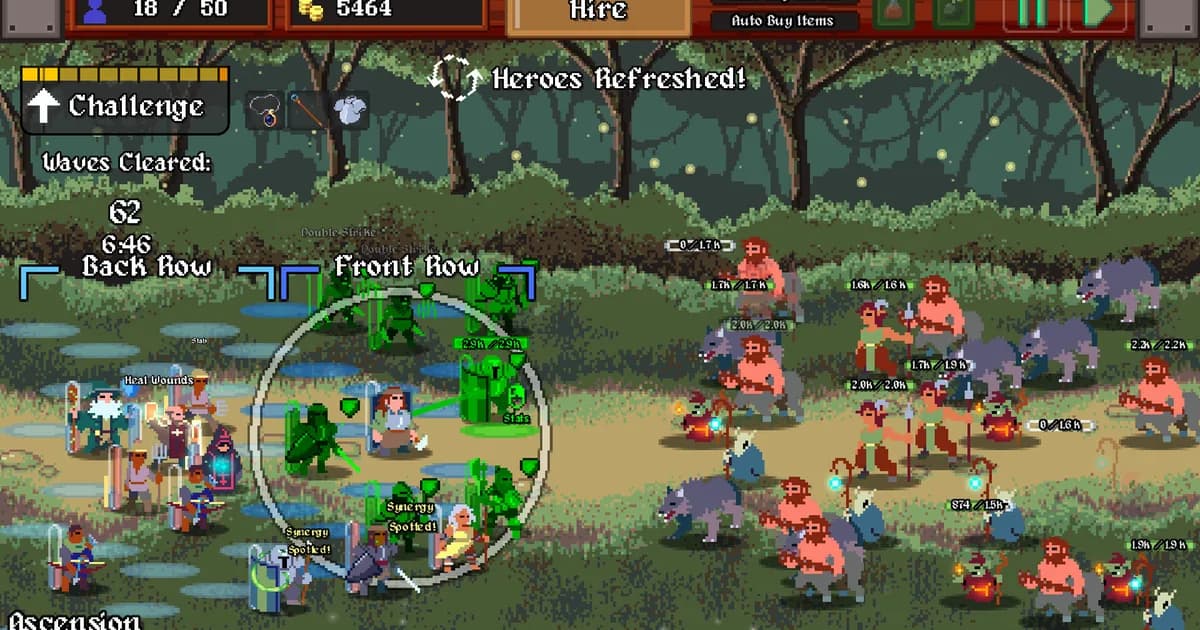
About the game
LegionBound
Spicy Garlic Games · Spicy Garlic Games
The LegionBound Warrior group is the game's widest class loop, but the useful part is not collecting every name. It is understanding which class supplies the next synergy, then building one short chain that actually fits the formation. This guide maps all 14 current Warrior-group classes, explains the direction of each pairing, and gives two practical routes instead of pretending a full roster is always optimal.
TL;DR: The LegionBound Warrior group contains 14 classes in a circular chain: Warrior, Sorcerer, Witch, Cleric, Paladin, Priest, Knight, Smith, Guardian, Shield Mage, Battlemage, Wizard, Druid, and Lumberjack. Each class points to the next one, such as Warrior to Spellblade with Sorcerer and Wizard to Magus with Druid. Start with a pair, then build either Warrior-Sorcerer-Witch for damage or Knight-Smith-Guardian for a sturdier front line.
Current status: September 2026 (quick answer)
LegionBound is currently listed on Steam at $7.99 in the US sale price, down from $9.99, with the promotion ending September 28, 2026 when checked for this audit. The official page shows 82% positive from 687 all-time reviews and 80% positive from 45 recent reviews. It also lists 42 classes, over 800 possible Ascension heroes, Battle Mode, Adventure Mode, and parties that can field up to 50 heroes.
That current roster is important because older versions of this article called the loop part of an “original 30” roster. The 14-class chain is still the subject of this guide, but the game now advertises 42 total classes. Treat the class reference below as the current loop map and check in-game descriptions after updates.
LegionBound Warrior group: the 14-class loop
The loop is ordered, not a flat faction list. Read the arrows as “the class on the right is the partner that upgrades the class on the left.” The sequence closes at the end:
- Warrior -> Spellblade with Sorcerer
- Sorcerer -> Warlock with Witch
- Witch -> Hexer with Cleric
- Cleric -> Mender with Paladin
- Paladin -> Templar with Priest
- Priest -> Bishop with Knight
- Knight -> Stalwart with Smith
- Smith -> Armorer with Guardian
- Guardian -> Bulwark with Shield Mage
- Shield Mage -> Bastion with Battlemage
- Battlemage -> Enchanter with Wizard
- Wizard -> Magus with Druid
- Druid -> Grovekeeper with Lumberjack
- Lumberjack -> Axeman with Warrior
The direction matters. A Warrior and Sorcerer pair upgrades Warrior into Spellblade; it does not mean that the same pair also upgrades Sorcerer. To upgrade Sorcerer, you need Witch. That one-way relationship is why a scattered group of familiar classes can underperform a smaller chain that is pointed in the right direction.
A synergy pair is valuable because it changes one existing hero slot. It is not a reason to recruit every class in the group at once.
Current synergy rules to remember
The current class reference describes these as teacher and student relationships. In practical terms, field the class and the next partner, then satisfy the game's activation condition. The subclass is an upgraded state of the earlier class, not a new unit you buy from the recruit pool.
That distinction solves three common mistakes:
- Pairing the wrong direction: Warrior needs Sorcerer, while Sorcerer needs Witch.
- Assuming a permanent evolution: Removing the partner can remove the active synergy state, so build around stable pairs.
- Overbuilding the loop: A two-class pair already has value. The remaining ten classes are options, not a mandatory shopping list.
When a patch changes a trigger, trust the class card and the current in-game UI. The external class reference is useful for the map of names, but it cannot override a new tooltip.
The best focused chains
Warrior, Sorcerer, Witch: damage first
This is the easiest route to explain because its first two upgrades line up naturally. Sorcerer upgrades Warrior into Spellblade, and Witch upgrades Sorcerer into Warlock. Witch itself needs Cleric if you want to continue the loop, so stop at three when you want a compact offensive core or extend to Cleric when the rest of the formation can carry it.
Use this chain when your problem is failing damage checks or leaving enemies alive long enough to overwhelm your front row. It is not automatically the best answer to every map. If the formation collapses before the spells and attacks matter, add a defensive pair rather than adding a fourth damage class.
Knight, Smith, Guardian: front-line sustain
Knight upgrades with Smith, and Smith upgrades with Guardian. The result is a practical three-class route for players whose damage is already adequate but whose front line breaks too early. Add Shield Mage if you want to continue toward the next link, but do not sacrifice a working damage pair merely to make the list longer.
The two routes also combine well. A Knight-Smith-Guardian front line can buy time for a Warrior-Sorcerer-Witch back line. The strength comes from two short chains doing different jobs, not from activating all 14 classes.
A damage chain and a sustain chain cover more of a run than a loose collection of unpaired Warrior-group recruits.
Step-by-step: build the Warrior group in a run
1. Identify your first class: Check whether the shop or your starting choices gave you Warrior, Wizard, Cleric, or another member of the loop. Treat that class as an entry point, not as a commitment to the entire 14-class roster.
2. Buy the next partner: Use the ordered list above. If you have Warrior, look for Sorcerer. If you have Knight, look for Smith. A correct adjacent pair is more valuable than a familiar class that has no current partner.
3. Stabilize the first subclass: Keep both partners on the field long enough to verify that the subclass is active. If the effect disappears when you move one unit, the formation is telling you that the relationship is conditional.
4. Choose a direction: Push toward Warrior-Sorcerer-Witch when damage is the bottleneck, or Knight-Smith-Guardian when survival is the bottleneck. Do not chase both chains if doing so forces you to sell a stronger unrelated unit.
5. Add the second chain only after the first works: A second pair should solve a visible problem. Recruit it to add damage, durability, or a needed role, not to make the roster look complete.
6. Use Ascension after the base loop is stable: LegionBound's Ascension system sits on top of class synergy. Read the LegionBound Ascension guide before merging away a class that supplies a partner you still need.
Why not complete all 14?
The full loop is valuable as a reference map, especially if you want to experiment with late-run formations. It is usually a poor early-run objective. Every recruit occupies a slot, costs resources, and can dilute the roles that let your current chain survive.
The official Steam listing now advertises a large roster and more than 800 possible Ascension heroes. That scale makes focused composition more important, not less. The bigger the pool, the more often a “collect them all” approach produces isolated units with no active partner.
Use the loop as a menu. Find a pair, extend it when the next class is offered, and stop when the added class no longer improves the formation. The LegionBound tips guide covers the broader recruit and positioning fundamentals if the class arrows are not yet the main problem.
Frequently asked questions
What is the LegionBound Warrior group?
It is a 14-class synergy loop containing Warrior, Sorcerer, Witch, Cleric, Paladin, Priest, Knight, Smith, Guardian, Shield Mage, Battlemage, Wizard, Druid, and Lumberjack.
What is the Warrior's synergy subclass?
Warrior becomes Spellblade with Sorcerer as its required partner. Spellblade is the Warrior slot's synergy state, not a separate recruit.
Does Warrior need Witch to become Spellblade?
No. Warrior's next partner is Sorcerer. Witch is the partner that upgrades Sorcerer into Warlock. Follow the arrow direction rather than treating the group as an unordered set.
What is the best Warrior group build?
Warrior-Sorcerer-Witch is the focused damage chain. Knight-Smith-Guardian is the focused sustain chain. Combine them only when your shop and formation can support both.
Do I need all 14 classes?
No. One correct pair can activate a subclass. Three classes can activate two links if the chain is ordered correctly. Completing the full loop is optional experimentation.
How many classes does LegionBound have now?
The current Steam listing says 42 classes and over 800 possible Ascension heroes. This guide covers the 14-class Warrior group within that larger roster.
Related Reading
- LegionBound Synergy Guide: All 42 Classes: the complete class and loop map.
- LegionBound Ascension Guide: how hero merging interacts with synergy.
- LegionBound Tips Guide: recruit, positioning, and run fundamentals.
- LegionBound Battle Mode Guide: endurance-run priorities.
- LegionBound Complete Guide Hub: modes, classes, and builds.
References
- Legionbound on Steam: current roster, modes, price, and live review snapshot.
- Legionbound class reference: current class loops and teacher or student relationships.
- Legionbound synergy guide: current subclass names and pairing table.
- Legionbound advanced builds: focused late-run subchains.
Was this guide helpful?
About the author

Senior Critic & Analyst
Former game data analyst turned critic with 11 years covering indie and mid-tier games. Based in Austin. Runs spreadsheets on games most people just play.
- 11 years games criticism
- Former game economy analyst
- Roguelike and strategy specialist
Keep reading
LegionBound Barkeep Group: All 11 Classes & Synergies
Guides · 8 min
LegionBound Ascension Chain: Timing, Risk, Recovery 2026
General · 10 min
LegionBound Gold Farming: Coins, Gems, Economy Guide 2026
General · 11 min

LegionBound Builds: Beat the Endbringer on Loop 2+
Guides · 9 min
LegionBound Tier List 2026: Ranking 30 of 42 Classes
Guides · 15 min
LegionBound Adventure Mode Guide: 5 Steps to Clear
Guides · 16 min
Game deals · affiliate links

Disclaimer
This article is published for informational and entertainment purposes. It does not constitute professional financial, legal, or technical advice. Game performance, online services, patch schedules, and store listings change. Verify critical details (pricing, system requirements, regional availability) with publishers and storefronts before you buy. Affiliate links, where present, help support our editorial work and are labelled in our affiliate disclosure.
Comments
Loading comments…